Electric heaters are close to 100% efficient: nearly every watt you pay for ends up as heat in the room, whatever the type or the marketing claims. So the useful questions are where that heat goes, how long it stays, and how much of the time the heater actually runs.
Radiant heat versus warm air
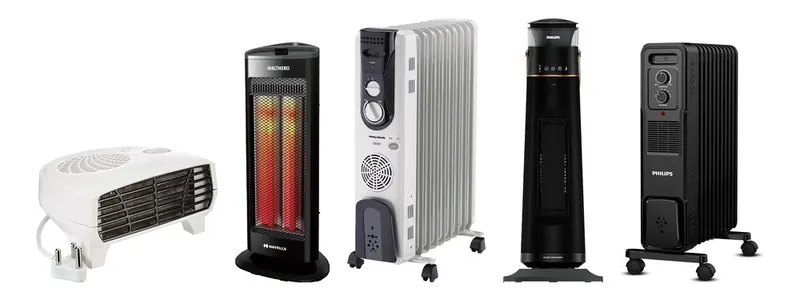
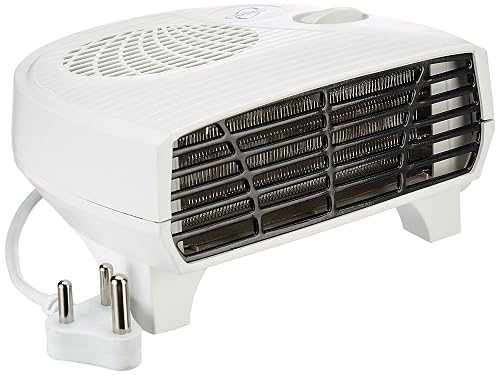
Heat travels in two ways that matter here. Radiant heaters (halogen, quartz, carbon) send infrared in a straight line, the way sunlight warms your face on a cold day. You feel it within seconds, but only in the beam, and the air around you stays cold. Convective heaters (fan, PTC, oil-filled) warm the air, which circulates and slowly brings the walls, floor and furniture up to temperature. That takes longer, but it is the only way to make a whole room comfortable. A fan just speeds convection up; an oil-filled radiator does it silently, using the warm air rising off its fins.
Why an oil-filled radiator stays warm after it switches off
The oil in an OFR is sealed in for life; it is never burned or topped up. It is simply a heat store. Ten kilos of oil and steel take a long time to warm, which is why an OFR is slow to start, and the same mass keeps giving off heat after the element cuts out. That smooths out the thermostat cycle: instead of a blast of hot air, then a cold gap, the room stays near the set temperature. It is also why an OFR’s surface runs much cooler than a glowing element, which matters around children and bedding.
What a thermostat really saves
Without a thermostat a heater draws its full rating for every minute it is on. With one, it heats the room to the set temperature and then switches on and off to hold it, so over a long night it runs only part of the time. How much it saves depends on the room, the insulation and how cold it is outside, so ignore precise percentages on the box. The rule that holds is simple: the longer the heater runs, the more a thermostat pays for itself. For a ten-minute warm-up it hardly matters; for an eight-hour night it decides your bill.
Reading watts, amps and units
Power in watts is the heat a heater can deliver, and also what it costs: a 2,000W heater on full uses 2 units (kilowatt-hours) an hour, about ₹16 an hour at ₹8 a unit. An 800W halogen costs about ₹6.40 an hour at the same rate. Check the per-unit tariff on your own bill, because slabs vary a lot by state. Current in amps is watts divided by 230: that 2,000W heater pulls about 8.7A, more than a 6A socket or a cheap extension board is built for, which is why it needs a large-pin 16A socket of its own.