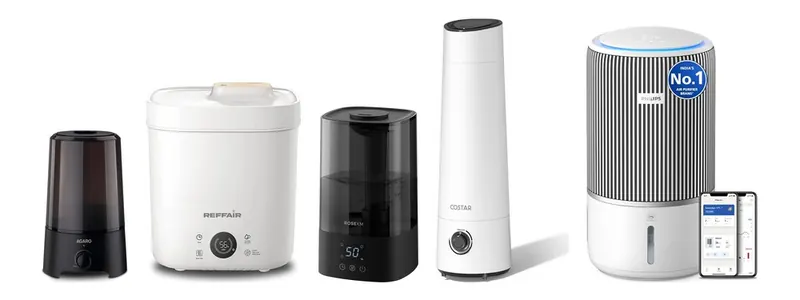
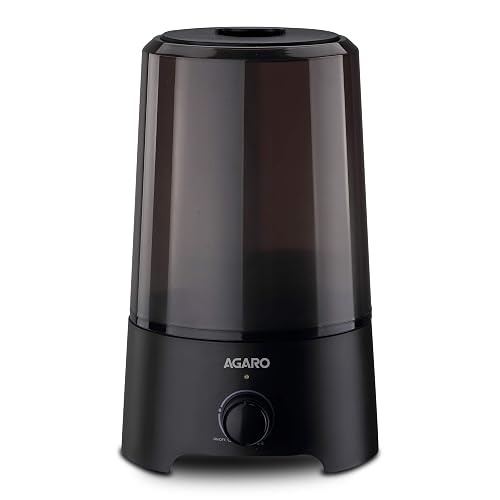
Every humidifier does the same job: it turns liquid water into vapour so the air can carry it. The differences are in how much water it moves an hour, how it decides when to stop, and what else comes out with the moisture.
Relative humidity, and why heating dries the air
Relative humidity is how much water the air holds compared with the most it could hold at that temperature. Warm air can hold far more, so when a heater warms a closed room the water in the air stays the same while its capacity rises, and the relative humidity falls. A room at 50% on a cold morning can fall to around 30% once the heater has run for an hour. That is why dryness peaks in heated bedrooms, and why a humidifier and a heater work well as a pair.
Ultrasonic plates and white dust
An ultrasonic humidifier has a ceramic disc, the transducer, under the water. It vibrates at ultrasonic frequency and throws tiny droplets off the surface, which a small fan pushes out of the nozzle. Because the water is shattered rather than evaporated, everything dissolved in it comes out too. With hard water, those minerals dry into a fine white dust. RO or distilled water mostly solves it; so does an evaporative model, which leaves the minerals in its wick.
What auto mode and a humidistat actually do
A humidistat is a humidity sensor wired to the controls. In auto mode the humidifier mists hard when the room is dry, slows as it approaches the target, and pauses once it gets there. The sensor sits on the unit itself, so it reads the damp air right next to the nozzle a little high; that errs on the safe side. Check where a model’s auto mode stops: anything that only pauses at 70% is above the range that keeps walls dry.
Reading ml/h, tank size and watts
Output in ml/h is the number that decides whether the humidifier can move a room’s humidity at all; tank size divided by output gives the runtime. Power draw matters less than you might expect: a cool-mist ultrasonic uses about as much as an LED bulb, roughly ₹2 for a ten-hour night at ₹8 a unit. Warm mist at 100W or more costs four times that, still small next to the 2,000W heater it often sits beside.