
Launch Coverage
Apple iPhone Duo
The First Foldable iPhone, Feature by Feature
Nineteen years after the original, Apple has folded the iPhone in half. The Duo pairs a 5.4-inch outer screen with a 7.6-inch folding one, drops Face ID for a Touch ID side button, and rebuilds iOS around a hinge. It lands in India on 23 October from ₹2,99,900. Here is every part of it, taken apart one at a time.
Published Sep 10, 2026 · Updated Sep 10, 2026
Overview
Apple folded the iPhone, and changed more than the shape
Apple introduced the iPhone Duo on 9 September 2026 at its “Surprise and Shine” event — the first keynote led by John Ternus, who succeeded Tim Cook as CEO on 1 September. It is the first foldable iPhone, and Apple's framing was not modest.
iPhone Duo is the most transformational change to iPhone since the original.
John Ternus, CEO, Apple — 9 September 2026
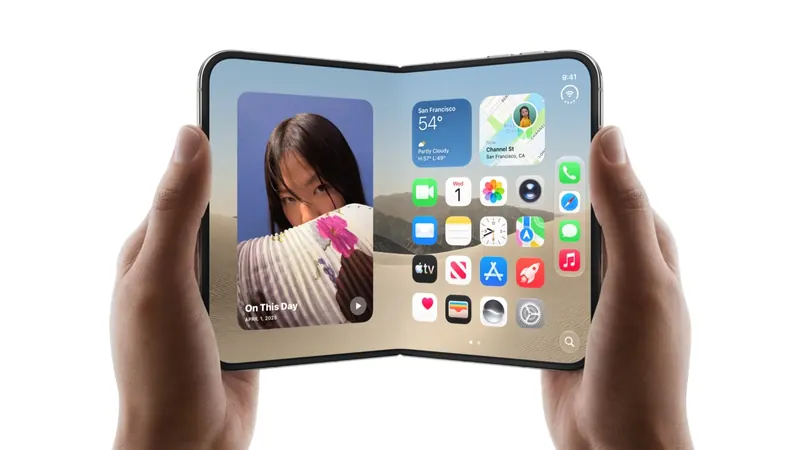
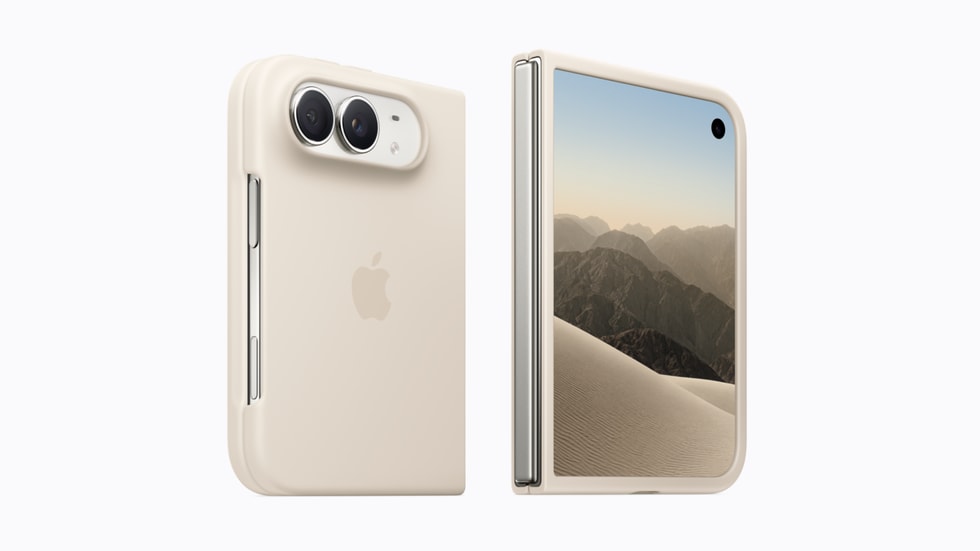
The shape is the passport-style book fold Samsung has sold for seven generations, but almost nothing underneath is a copy. Closed, a 5.4-inch outer display gives you 90% of the screen area of an iPhone 18 Pro. Opened, a 7.6-inch inner display unfolds to 5.2mm — the thinnest iPhone Apple has built.
7.6″
Inner display
5.2mm
Open thickness
254g
Weight
₹2.99L
India, from

Two decisions show how much Apple gave up for the form factor. Face ID is gone, replaced by Touch ID in the side button, because the TrueDepth array would not fit. And the inner selfie camera has moved under the display — a technology every Android maker who shipped it has had to apologise for.
Pre-orders open 16 October; it goes on sale 23 October in 70+ countries including India, from ₹2,99,900. What follows takes the device apart one piece at a time.
Reference
iPhone Duo: the full spec sheet
Scroll right on smaller screens.
| Component | Specification |
|---|---|
| Inner display | 7.6″ foldable Super Retina XDR OLED · 1878×2670 · 430 ppi · ProMotion 120Hz · Always-On · 3000 nits peak outdoor · nano-texture finish |
| Outer display | 5.4″ Super Retina XDR OLED · 1398×2034 · 460 ppi · ProMotion 120Hz · Always-On · 3000 nits peak outdoor · Ceramic Shield 2 |
| Chip | A20 Pro, 2nm · 6-core CPU · 7-core GPU · Dual 16-core Neural Engine · custom vapor chamber |
| Storage | 256GB · 512GB · 1TB · 2TB (no microSD; eSIM-only) |
| Rear cameras | 48MP Fusion Main, ƒ/1.6, 26mm, sensor-shift OIS, 2× optical-quality Telephoto · 48MP Fusion Ultra Wide, ƒ/2.2, 13mm, macro |
| Front cameras | 12MP Center Stage on the outer display, ƒ/2.2 · under-display FaceTime camera on the inner display, ƒ/1.8 |
| Video | 4K120 Dolby Vision (Main) · Cinematic effects post-capture to 60 fps · 4K Dolby Vision time-lapse · Dual Capture |
| Battery life | Up to 31h video on the inner display · up to 44h on the outer · up to 24h with both used equally · dual cells, one per side |
| Charging | 50% in ~20 min wired (60W USB-C) · 50% in ~30 min on MagSafe or Qi2 |
| Unfolded size | 164.6 × 117.8 × 5.2 mm |
| Folded size | 84.1 × 117.8 × 11.3 mm |
| Weight | 254 g |
| Build | Grade 5 titanium, mirror-polished · 3D-printed hinge cover · Ceramic Shield back · Ceramic Shield 2 front · IP68 (6m / 30 min) |
| Biometrics | Touch ID in the side button — works open or closed · unlock with Apple Watch · no Face ID |
| Connectivity | N1 chip: Wi-Fi 7, Bluetooth 6, Thread · C2 modem with mmWave (US) · eSIM only worldwide |
| Software | Ships with iOS 27.1 · Apple Intelligence · Siri AI (beta) · Apple Pencil with USB-C support later in 2026 |
| Colours | Star White · Night Sky |
| India price | ₹2,99,900 / ₹3,24,900 / ₹3,74,900 / ₹4,49,900 |
| Key dates | Announced 9 Sep 2026 · pre-order 16 Oct · on sale 23 Oct |
Source: Apple's official iPhone Duo tech specs and press release, 9 September 2026.
Head to head
iPhone Duo vs Galaxy Z Fold8
Scroll right on smaller screens.
The Z Fold8 is the phone the Duo will actually be cross-shopped against in India, and it is on sale today at ₹1,74,999. Put the two spec sheets side by side and the result is less flattering to Apple than the keynote suggested.
+₹1.25L
Duo price premium
+53g
Duo is heavier
IP68 vs IP48
Duo dust rating wins
| Spec | Apple iPhone Duo | Samsung Galaxy Z Fold8 |
|---|---|---|
| Inner display | 7.6″ · 1878×2670 · 430 ppi · 120Hz · 3000 nits · nano-texture matte | 7.6″ · 1848×2448 (4:3) · 404 ppi · 120Hz · 3000 nits |
| Cover display | 5.4″ · 1398×2034 · 460 ppi · same aspect as inner | 5.5″ · 1248×1972 · 428 ppi |
| Unfolded | 164.6 × 117.8 × 5.2 mm | 161.4 × 123.9 × 4.5 mm |
| Folded | 84.1 × 117.8 × 11.3 mm | 81.9 × 123.9 × 9.7 mm |
| Weight | 254 g | 201 g |
| Chip | A20 Pro · 2nm · 6-core CPU, 7-core GPU | Snapdragon 8 Elite Gen 5 |
| RAM | Not disclosed by Apple | 12GB / 16GB |
| Rear cameras | 48MP ƒ/1.6 Main + 48MP ƒ/2.2 Ultra Wide · 2× sensor crop | 50MP ƒ/1.8 Wide + 50MP ƒ/1.9 Ultra Wide |
| Front cameras | 12MP cover · under-display inner (resolution undisclosed) | 10MP cover · 10MP inner (visible cutout) |
| Video | 4K120 Dolby Vision | 8K30 · 4K120 |
| Battery | Dual cells · up to 24h mixed use (Apple rating) | 4800 mAh |
| Charging | 50% in ~20 min (60W) · 25W MagSafe/Qi2 | 45W wired (63% in 30 min) · 20W wireless |
| Ingress rating | IP68 — 6m / 30 min | IP48 — limited dust protection |
| Biometrics | Touch ID side button only | Fingerprint + face unlock |
| Stylus | Apple Pencil (USB-C) — later in 2026 | No S Pen support on Fold8 |
| OS | iOS 27.1 | Android 17 · One UI 9 |
| India, 256GB | ₹2,99,900 | ₹1,74,999 |
| Availability | 23 October 2026 | On sale now |
Blue highlights the better figure on each row where one is objectively better. Battery is deliberately not scored: Apple publishes hours and not milliamp-hours, Samsung the reverse, and the two cannot be compared. Z Fold8 price is the live Amazon.in listing on 10 September 2026; specifications from GSMArena.
What the table actually says
Samsung wins the physics. The Fold8 is thinner open and closed, 53g lighter, and costs ₹1,24,901 less. Apple's “thinnest iPhone ever” is not the thinnest foldable — it is 0.7mm thicker open and 1.6mm thicker closed than the phone already on shelves.
Apple wins where it usually does: the IP68 rating against Samsung's IP48 is a real durability gap on a hinged device, the matte nano-texture panel has no equivalent, the cover screen is sharper and shares the inner display's aspect ratio, and charging is faster. Whether that is worth a 71% premium is the question the reviews will have to answer.
Item 01 — Screens
The two screens

Almost every design decision traces back to one choice: the two displays share an aspect ratio. On every book-style foldable before it, the cover screen is a tall letterbox and the inner one nearly square, so opening the device forces every app to reflow. Apple matched the ratios, so content scales instead.
Inner
7.6″
- Resolution
- 1878×2670
- Density
- 430 ppi
- Refresh
- 120Hz ProMotion
- Peak
- 3000 nits
- Finish
- Nano-texture matte
Outer
5.4″
- Resolution
- 1398×2034
- Density
- 460 ppi
- Refresh
- 120Hz ProMotion
- Peak
- 3000 nits
- Cover
- Ceramic Shield 2
Why matte matters more than you think
Apple has put its nano-texture finish — the etched anti-glare treatment from the Pro Display XDR — across the entire folding area. MacRumors reports it is produced by maskless laser lithography, giving a micro-lens texture rather than a coating.
It does two jobs at once. It kills reflections, and because a matte surface scatters light instead of mirroring it, it makes the crease far harder to see. A crease is visible because it bends reflections; remove the reflections and you remove most of the tell.
The camera that isn't there
No notch, no Dynamic Island cutout, no hole punch in the inner display. The FaceTime camera sits under the panel and vanishes when idle. Apple has published an ƒ/1.8 aperture and no resolution — an omission worth noticing. This is the single specification most likely to disappoint in reviews.
Apple Pencil, eventually
The Duo is the first iPhone to support Apple Pencil (USB-C) on either display. It is not there at launch: Apple says “later this year”, so day-one buyers are buying a promise.
Item 02 — Hardware
The body, the hinge and what stops it breaking
Foldables fail in predictable places: grit in the hinge, a delaminating panel, a frame that flexes until something inside stops making contact. Apple's answers are unusually specific — the press release spends more words on durability than on the camera.

100+
Hinge components
Grade 5
Titanium frame
3×
Scratch resistance
IP68
6m / 30 min
Grade 5 titanium, mirror-polished
The enclosure is grade 5 titanium with a mirror finish; the hinge cover is 3D-printed in a contrasting micro-blasted texture — the additive process Apple introduced on the Apple Watch. Inside, support ribs add stiffness and the antenna splits carry ceramic fibre inserts, so the breaks the radios need don't become weak points in a chassis already cut in half.
The hinge: more than 100 components
Two claims stand out. It supports the centre of the display to hold it flat when open — a mechanism pushing against the panel from behind at the fold, which is how you stop a large flexible sheet dishing in the middle. And an integrated magnet array handles closure, so the phone snaps shut rather than relying on hinge friction.
The display stack — layers that slide
This is the most interesting engineering on the device. A folding panel fails because its layers are bonded rigidly, and through a bend the outer layers must travel further than the inner ones. Apple's answer is to stop fighting that and let them move.
Note what remains true despite all of it: the inner display is polymer-topped, not glass, and it will scratch more easily than the outer screen. Apple's own word is “scratch-resistant”.
Ceramic Shield, and IP68
Ceramic Shield protects the back; Ceramic Shield 2 on the front cuts glare and offers 3× the scratch resistance of the previous generation. The device is rated IP68 — 6 metres for 30 minutes. That dust rating on a hinged device is a genuine achievement: the first Android foldables carried no dust rating at all, and grit in the hinge was their commonest failure.
Touch ID is back, and Face ID is gone
The Duo unlocks with Touch ID in the side button, working open or closed, with multiple fingers, and it can be paired with unlock-with-Apple-Watch. Ming-Chi Kuo reported this months ahead of launch, attributing it to internal volume.
Be clear-eyed about the trade. Touch ID is fast and works in the dark, but it fails with wet or cold fingers and it does not authenticate passively — every Apple Pay confirmation becomes a deliberate thumb press. On a ₹3 lakh phone in 2026, several hands-on writers called this the clearest regression, and we would agree until proven otherwise.
Camera Control
The right edge also carries Camera Control, which launches the camera and opens the new Siri Camera mode — point the phone at something and let Siri see what you see. Gizmodo's hands-on confirmed it works in both folded states.
Item 03 — In the hand
Handling, thickness and the crease
Specifications mislead more than usual on a foldable, because the numbers that matter are the ones you feel. Here is what Apple published, and what people who held one on press day said.
5.2mm
Open
11.3mm
Closed
254g
Weight
117.8mm
Height, both states
Thin open, category-normal closed
5.2mm unfolded is legitimately the thinnest iPhone Apple has made. But a foldable spends most of its life shut, and shut it is 11.3mm — roughly two iPhone 18 Pros stacked, and 1.6mm thicker than a Galaxy Z Fold8. Apple has matched the category here, not redefined it.
254 grams is the number to sit with
Held open like a small book it is fine: the weight spreads across two hands and a wide footprint. Held closed and one-handed while you scroll that 5.4-inch cover screen — which Apple explicitly encourages — a quarter of a kilo in a narrow body will make itself known.
The inner matte nano-texture display looks like paper. But the crease is still visible at various angles, much like other foldables.
Gizmodo, iPhone Duo hands-on — 9 September 2026
The crease is still there
The nano-texture finish substantially reduces how visible the fold is, and reviewers were consistent that the matte panel is the most striking thing about the device. But the same hands-on was equally clear that the crease remains visible at some angles. Apple's own language is careful: the finish “minimises crease visibility”. Nobody has solved this, Apple included.
Confidence in the mechanism
The recurring press-day note was structural reassurance rather than delight — the titanium frame and hinge together, in Gizmodo's words, don't feel like the phone “will snap in half if you bend it back enough.” For a first-generation folding device that is the right thing for reviewers to be reporting, and no spec sheet can tell you it.
Item 04 — Software
Every iOS 27.1 change, and the animations
The Duo does not ship on iOS 27.0. It ships on iOS 27.1 in October, a month after iOS 27 reaches every other iPhone on 14 September. That gap is the tell: the foldable work is a distinct body of software, not a checkbox in the main release.

The interface moved sideways
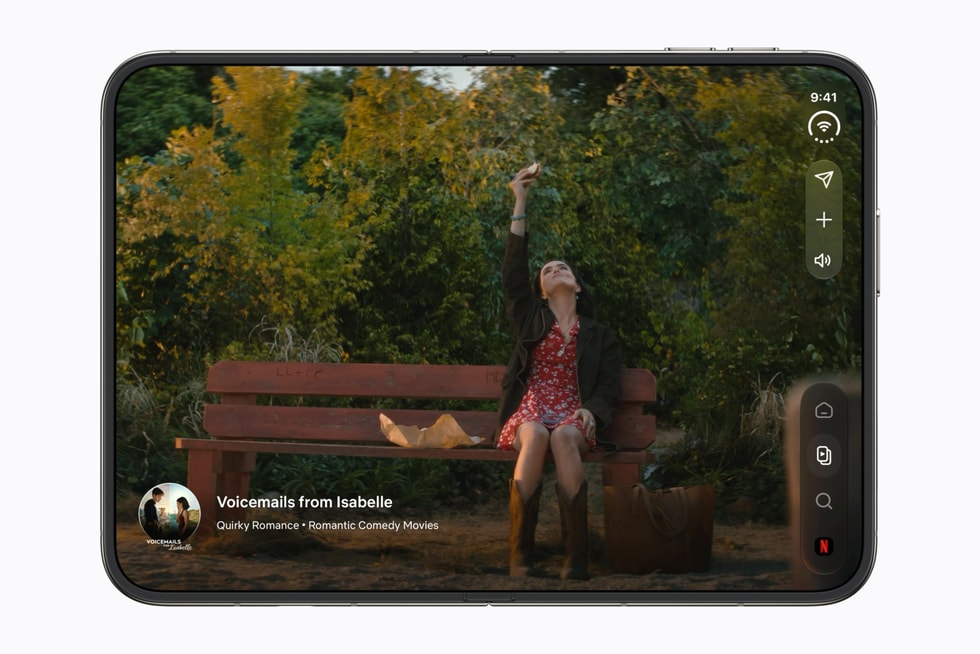
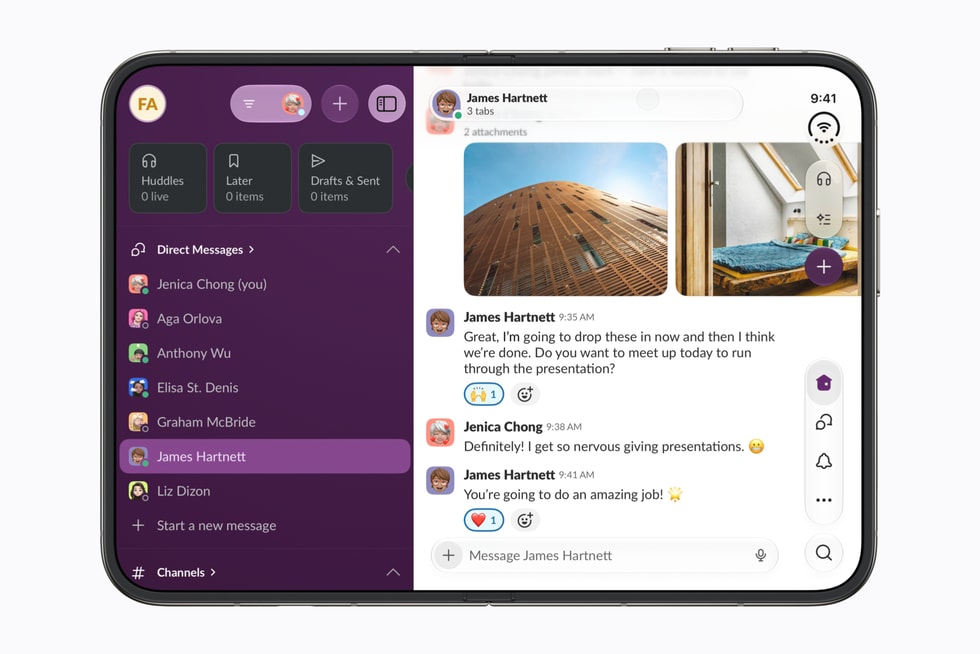
iOS has reorganised around vertical space being scarce and horizontal space plentiful. Three things that lived at the top or bottom of an iPhone for years have moved to the edge:
Dock
Now vertical, on the side
Status bar
Circular corner cluster
Dynamic Island
Runs vertically, both screens
Gizmodo observed the Dock on the right, within reach of a right thumb; whether it can be moved for left-handed users is not documented. Lock Screen controls and in-app navigation shift to the side too. The Dynamic Island still expands for Live Activities — a small change with a large implication, since the Island began as a way to make a camera cutout useful and the Duo's inner camera is invisible.
The animations — what happens when you fold it
- Content reacts as it folds. The interface responds continuously through the arc of the hinge, not in a snap at the end — a new display engine in A20 Pro drives both panels simultaneously, so the handoff can be animated rather than cut.
- It reorients when turned to the side, reflowing layouts as you rotate it held partly open.
- It switches display when flipped over. Turn the closed device around and what you were doing follows you to the screen now facing you.
- Content avoids the crease when held partially folded — controls settle on one half, content on the other, in the laptop-style pose.

Split View, on an iPhone, for the first time
Open, the inner display shows two Home Screen pages side by side with Today View — a vertically scrolling widget column — pinned left. And multitasking finally arrives properly.
- Split View puts two apps side by side on an iPhone for the first time ever.
- You can open two windows of the same app — Apple's example is Safari, for comparison shopping.
- App pairs can be saved and reopened later as a unit.
- You can hold a conversation with Siri AI on one half while reading on the other.

StandBy, upgraded
Put the Duo down and it enters StandBy on whichever display faces up — and crucially, even when it is not charging, which the existing iPhone implementation requires. A device that stands on its own hinge is a natural desk clock or photo frame. New Calendar and Weather faces join Clock and Modular, the Photos face now pulls from Shared Albums, and every face gains new colours, fonts and complications.
Third-party apps are already there
Four launch partners, with more specific examples than the usual logo parade. Netflix lets you scroll Clips on the outer display and open up for the full browse. Zoom turns the inner display into a conference room showing shared content and participants together. Slack brings a whole workspace into one view. Detail runs on-device models through the new Core AI framework.
Siri AI and Apple Intelligence
The Duo ships into the middle of Apple's Siri rebuild. Siri AI arrives as a beta with iOS 27 on 14 September in English, with French, Japanese, Korean, Portuguese and Spanish in October. It brings personal-context understanding across messages, email and photos, onscreen awareness, world knowledge, and a “write with Siri” mode anywhere you type. A dedicated Siri app syncs conversation history privately across your devices.
Elsewhere: Spatial Reframing, Extend and an upgraded Clean Up recompose photos after capture; Image Playground gains photorealistic output and upcoming SynthID support; Safari's Notify Me watches pages for restocks and price drops; and Call Context surfaces your confirmation code when you ring a business.
Item 05 — Cameras
The cameras, and the tricks only a folding phone can do
The sensors are largely shared with the iPhone 18 Pro. What is new is what a second screen and the ability to stand the phone up let you do with them — the most convincing argument in the whole launch for the form factor mattering rather than merely existing.
48MP
Fusion Main, ƒ/1.6
48MP
Ultra Wide, ƒ/2.2
2×
Telephoto, sensor crop
4K120
Dolby Vision video
The hardware
- 48MP Fusion Main — ƒ/1.6, 26mm, sensor-shift OIS, zero shutter lag, with an integrated optical-quality 2× Telephoto cropped from the sensor.
- 48MP Fusion Ultra Wide — ƒ/2.2, 13mm, macro capable. Same unit as the iPhone 18 Pro.
- 12MP Center Stage outer front camera, ƒ/2.2, which widens the frame when someone joins and can rotate it so you never turn the phone for a landscape selfie.
- Under-display FaceTime camera on the inner display, ƒ/1.8, hidden when idle.
- 24MP default rear capture for sensible file sizes, with full 48MP available.
There is no dedicated periscope telephoto. On a ₹3 lakh phone, 2× from a sensor crop is the specification most obviously subordinated to thinness — and the one place the Z Fold8 does not beat it either.


Video
4K120 in Dolby Vision on the main camera, so slow motion becomes a playback-speed decision made afterwards. Cinematic effects apply post-capture at up to 60fps. Audio Mix gains algorithms that clean up voices and now isolate music. Time-lapse supports 4K Dolby Vision HDR — and because the Duo stands on its own hinge, you can shoot a long one without a tripod.
The five Duo-only camera modes
Rear-camera selfies
Shoot yourself with the 48MP rear cameras and frame it on the outer display. Your selfies are now taken on the good cameras — the single most useful consequence of the form factor.
Duo Preview
The person being photographed sees a live preview on the outer display, so they can fix their own framing and pose instead of asking you to check the shot afterwards.
Smart Take
On-device models running on A20 Pro watch the scene and fire the shutter automatically when subjects are posing, so whoever is holding the phone can be in the group photo without a timer sprint.
Kid Cue
Peanuts animations play on the outer display to make small children look at the lens. Slightly silly, and it will absolutely work.
Duo FaceTime & Dual Capture
Someone beside you joins your video call on the outer display and its camera, so two people share a call without crowding one screen. Dual Capture streams front and rear feeds simultaneously.

Photographic Styles, with grain
Photographic Styles gains texture and grain controls — meaningful for anyone who finds Apple's processing too clean. Grain is the most effective tool there is for making a very sharp computational image read as a photograph rather than a render.
Item 06 — Internals
A20 Pro, the dual battery and the radios
2nm
Process node
+20%
CPU vs A19 Pro
+40%
GPU vs A19 Pro
+35%
Sustained vs 17 Pro
A20 Pro, on 2nm
The Duo runs the same A20 Pro as the iPhone 18 Pro. Apple's figures against A19 Pro: a 6-core CPU up to 20% faster (which Apple claims is the fastest in any smartphone), a 7-core GPU up to 40% faster and more efficient, a new Dual 16-core Neural Engine with 2× the compute, and 50% more unified memory bandwidth. RAM is not disclosed; pre-launch reporting put it at 12GB, but Apple has not confirmed it and neither will we.
The vapor chamber, and why sustained performance is the real number
Peak benchmarks are the least interesting thing about a phone chip; what matters is what is left after ten minutes. Apple borrowed a chip package from M-series Apple silicon connecting A20 Pro directly to a custom vapor chamber, and quotes up to 35% better sustained performance than iPhone 17 Pro. A thin folding chassis has less metal to sink heat into, and this is Apple pre-empting the obvious criticism.
A new display engine drives both panels simultaneously, which is what lets the fold transitions animate rather than blank and redraw.
Two batteries behaving as one
Each half carries its own high-energy cell, which is how Apple fits meaningful capacity into two 5.2mm slabs. Apple silicon plus energy rebalancing algorithms make them operate as a single battery.
31h
Video, inner display
44h
Video, outer display
24h
Mixed use
~20min
To 50%, 60W
The 44-hour outer-display figure reframes the device: use the Duo mostly closed, as a normal phone, and its endurance is exceptional precisely because it carries two batteries to run one small screen.
eSIM only, everywhere
The Duo is eSIM-only worldwide — no SIM tray in any market, India included. Apple's stated reason is space: a tray costs internal volume that becomes battery. All major Indian networks handle eSIM, but it changes the mechanics of travel SIMs and of swapping a number into a spare handset in a hurry. iOS 27 adds iPhone Handoff, which moves one number between two iPhones on supporting carriers.
Radios
Two Apple-designed chips. N1 handles Wi-Fi 7, Bluetooth 6 and Thread. C2 is the next-generation cellular modem, which MacRumors reports is up to 50% faster than the C1X while drawing up to 15% less battery. mmWave 5G is US-only — no loss in India, where mmWave deployment is negligible.
The environmental line
35% recycled content overall, including 100% recycled cobalt in the batteries and 100% recycled titanium in the 3D-printed hinge cover, manufactured with 60% renewable energy, in 100% fibre-based packaging.
Watch
The launch, on video
Apple streamed the “Surprise and Shine” keynote on 9 September on apple.com, in the Apple TV app and on YouTube. Embedded through youtube-nocookie.com, so nothing tracks you unless you press play.
The 60-second version
The Reaction
What the people who cover Apple said
Two of these predate the keynote. Mark Gurman's reporting called the name, the price, the storage ceiling, the October ship date, Apple Pencil support and both colours before Apple said a word — worth keeping as a calibration point for the next leak cycle.
Apple landed on the iPhone Duo name for the foldable iPhone and a $2,000 starting price, eating the additional memory costs. Storage capacities will reach 2 terabytes and roughly $3,000. It'll ship in October, has support for the Apple Pencil and come in dark blue + white.
— Mark Gurman (@markgurman) September 9, 2026
Apple is trying to bring back the under-display selfie camera on the inner display on the iPhone Duo
— Marques Brownlee (@MKBHD) September 9, 2026
I expect the following iPhone 18 Pro colors: black, light blue, silver and burgundy. iPhone Duo colors: dark blue and white.
— Mark Gurman (@markgurman) September 9, 2026
iPhone Duo. What do we think of the name?
— Daniel (@ZONEofTECH) September 9, 2026
Gurman's colour call was directionally right and specifically wrong, which is the usual shape of these things: Apple shipped white and a dark navy, but named them Star White and Night Sky. The price was exact.
Money
Pricing in India, and in nine other markets
The iPhone Duo starts at ₹2,99,900 in India for 256GB and runs to ₹4,49,900 for 2TB. The entry model costs roughly what two iPhone 18 Pros do. Every figure below was read from Apple's own regional stores on 10 September 2026.
| Market | 256GB | 512GB | 1TB | 2TB |
|---|---|---|---|---|
| India | ₹2,99,900 | ₹3,24,900 | ₹3,74,900 | ₹4,49,900 |
| United States | $1,999 | $2,199 | $2,599 | $3,199 |
| United Kingdom | £1,999 | £2,199 | £2,599 | £3,199 |
| Germany (Eurozone) | €2,299 | €2,549 | €3,049 | €3,799 |
| UAE | AED 8,499 | AED 9,349 | AED 11,049 | AED 13,599 |
| Singapore | S$3,099 | S$3,399 | S$3,999 | S$4,899 |
| Australia | A$3,499 | A$3,899 | A$4,699 | A$5,899 |
| Canada | C$2,999 | C$3,299 | C$3,899 | C$4,799 |
| Japan | ¥364,800 | ¥399,800 | ¥469,800 | ¥574,800 |
These are Apple's actual local list prices, not currency conversions — each includes that market's own tax treatment, so they are not directly comparable. The currency switcher in our header deliberately does not apply here.
Why India pays so much more
₹2,99,900 is well above what $1,999 converts to. The gap is import duty on the finished device plus 18% GST — the same structure that has always separated Indian iPhone pricing from American, not anything specific to the Duo. The practical consequence is familiar: the Duo will be meaningfully cheaper carried back from Dubai or Singapore, and meaningfully riskier to service if you do.
The dates that matter
-
Wed 9 Sep 2026
iPhone Duo announced at “Surprise and Shine”, John Ternus's first keynote as CEO.
-
Mon 14 Sep 2026
iOS 27 and the Siri AI beta reach existing iPhones. The Duo does not use this build.
-
Fri 18 Sep 2026
iPhone 18 Pro and Pro Max go on sale — five weeks before the Duo.
-
Fri 16 Oct 2026 · 5:30 pm IST
Pre-orders open. Cases and the Folio go on sale the same day.
-
Fri 23 Oct 2026
On sale in India and 70+ countries including Australia, Brazil, Canada, China, France, Germany, Japan, Singapore, the UAE, the UK and the US.
-
Fri 30 Oct 2026
Second wave — 28 further countries and regions.
-
Later in 2026
Apple Pencil (USB-C) support arrives by software update. No firmer date given.
Accessories and India offers
- iPhone Duo Case — $79. A thin two-part design wrapping both halves separately, in sand and navy blue.
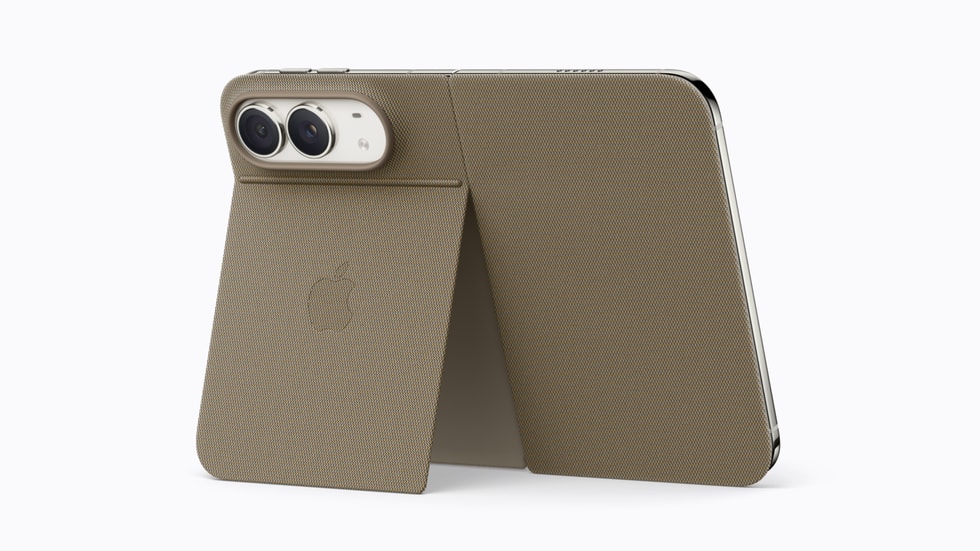
- iPhone Duo Folio with Kickstand — $129. Integrated kickstand supporting a range of angles, folding flat when unused, in navy blue and taupe.
- Both are MagSafe, Qi2 25W and Qi-certified compatible.
- India: Apple is listing No Cost EMI for up to six months plus instant cashback on select bank cards. Exact bank partners and cashback amounts are usually confirmed closer to pre-order day.
- US only: Apple Upgrade, a Klarna-provided lease, from $57.99/month over 24 months.
Our Method
How we sourced this article
We have not used an iPhone Duo. It does not go on sale until 23 October, so this is launch coverage, not a review, and we have written it that way on purpose. Every specification here — display sizes and resolutions, dimensions, weight, camera apertures, battery figures, chip claims, iOS 27.1 behaviour, materials and environmental data — comes from Apple's press release of 9 September 2026 and its published tech specs. Where a number is Apple's marketing claim rather than an independently measured result, we have said so in the sentence.
Every price in the table was read directly from Apple's regional online stores on 10 September 2026, one market at a time, rather than converted from dollars or copied from aggregators. Galaxy Z Fold8 specifications come from GSMArena and its price from the live Amazon.in listing on the same day. Subjective impressions of handling, thickness and crease visibility are attributed to the reporters who held the device on press day, principally Gizmodo's hands-on, and labelled as theirs rather than presented as ours. Pre-launch reporting from Mark Gurman and Ming-Chi Kuo is identified as reporting.
We earn no commission on this article: the iPhone Duo is not sold through any affiliate programme we participate in, and every link here goes to Apple, to YouTube or to the journalist being quoted. We will publish a full, scored review once we have bought and lived with a retail unit, and this page will be updated to link to it.
Our Take
The most convincing foldable yet —
and still a first-generation device
Apple has answered the two questions that kept foldables niche. Matching the aspect ratios of both screens fixes the app-reflow problem that made every previous book fold feel like two phones sharing a body. And putting nano-texture across the fold attacks the crease at its cause — reflections — rather than trying to flatten it away. Add a 44-hour cover-screen battery, IP68 on a hinge, and an iOS that genuinely moved its furniture, and this is the most complete first attempt anyone has made.
But the compromises are real, and not small:
- › No Face ID. Touch ID in the side button is a genuine step backwards for passive authentication.
- › An under-display camera with no published resolution. Historically the weakest part of every phone that shipped one.
- › No periscope telephoto. 2× from a sensor crop, at ₹2,99,900.
- › Heavier and thicker than a Galaxy Z Fold8 that costs ₹1,24,901 less.
- › Apple Pencil arrives later, and Siri AI ships as a beta with stated daily limits.
Our advice for India: at ₹2,99,900 this is not a phone you buy on a keynote. It is the most interesting hardware Apple has shipped in years, and it is also a first-generation folding device whose two most novel components — the hinge and the hidden camera — are exactly the ones that need months of real use to judge. Pre-orders open 16 October; independent reviews land in the week before the 23 October sale date. Wait for them.
View on Apple IndiaFAQ
Frequently Asked Questions
 Foldables
Best Foldable Phones in India 2026
What the Duo is up against — the book folds and flip phones you can actually buy today, with live Amazon.in pricing.
 Flagships
Best Flagship Phones Over ₹1 Lakh
If ₹2,99,900 is a stretch, this is the tier where the Duo's rivals actually sell.
 Smartphones
Best Premium Smartphones 2026
The phones most people cross-shop before spending flagship money, ranked and priced.
 Tablets
Best Tablets in India 2026
A 7.6-inch folding screen is not a tablet. If that is what you actually want, start here.
 Wearables
Best Smartwatches 2026
The Duo unlocks with an Apple Watch — here is how the current crop compares.
 Audio
Audio
Best TWS Earbuds in India
44 hours of video needs something to listen on — wireless earbuds ranked on ANC and battery.