Buying Guide

Best Camera Phones Under ₹30,000
2026 · Picked by What You Shoot

Seven phones from ₹17,999 to ₹28,999, one for each kind of photographer: the cheapest with optical stabilisation, the best ultrawide, steady 4K video, night shots, real zoom and the most daylight detail — plus which camera specs on the box actually change your photos.

16 min read India 7 picks

Independent picks: no paid placements, no free review units. Amazon’s live stock check is paused, so prices, stock and sellers come from the Amazon.in listings as we read them on 12 Nov 2026; confirm on the listing. How we pick ↓

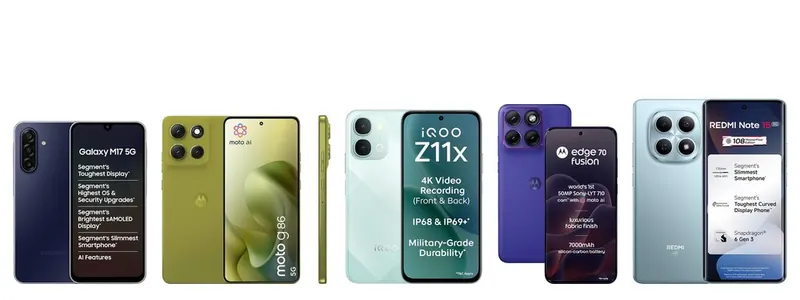
Best camera phones under Rs 30,000 in India 2026: Samsung, Motorola, iQOO and Redmi

Overview

Megapixels sell phones. Sensors take the photos

Under ₹30,000, every phone box promises a great camera, and most of them lead with a megapixel count. The things that actually decide your photos are less glamorous: how big and good the main sensor is, whether it has optical image stabilisation (OIS), and whether the second lens on the back is a useful ultrawide or telephoto or just a 2MP filler. Phone prices rose through 2026 as memory chips got dearer, so fewer phones at this price carry a second serious camera than a year ago.

This guide picks one phone per job: the cheapest phone with OIS, the best ultrawide, the cheapest steady 4K video, the night-photo specialist, the only real zoom lens we found, the best all-rounder and the most detailed daylight camera. All seven were in stock on Amazon.in at ₹17,999 to ₹28,999 when we checked. If the camera is not your first priority, our best phones under ₹30,000 guide ranks the all-rounders, and the under ₹15,000 guide covers tighter budgets.

One honest warning: several of these phones are sold on Amazon.in by third-party resellers rather than the brand or a big retail partner, and stock moves daily. Each card names the seller we saw, so you can check the return window before you buy.

Side-by-side

Camera Phone Comparison 2026

Scroll right on smaller screens to see all columns.

Phone Price Main camera Second lens Video Best for Rating Buy
Samsung Galaxy M17 5G in sapphire black with a 50MP OIS triple camera
Galaxy M17
Cheapest OIS
₹17,999 50MP, OIS5MP ultrawide1080pCheapest OIS 4.1 Amazon
Motorola Moto G77 Power in Pantone Impenetrable with a 50MP Sony LYTIA 600 camera
Moto G77 Power
Best Ultrawide
₹20,099 50MP Sony LYTIA 6008MP ultrawide (120°)2KWide landscapes 4.0 Amazon
Motorola G86 Power in Pantone Golden Cypress vegan leather with a Sony LYTIA 600 OIS camera
Moto G86 Power
Best for Video
₹26,749 50MP Sony LYTIA 600, OIS8MP ultrawide + macro4K (all cameras)Steady 4K video 4.2 Amazon
iQOO Z11x 5G in matrix green with a 50MP Sony IMX852 camera
iQOO Z11x
Best Low Light
₹27,999 50MP Sony IMX8522MP depth4K front + rearNight photos 4.2 Amazon
Nothing Phone (3a) Pro in black with its round triple camera and periscope telephoto
Nothing Phone (3a) Pro
Best Zoom
₹27,999 50MP50MP 3× periscope telephoto4KZoom and portraits 4.5 Amazon
Motorola Edge 70 Fusion in Pantone Orient Blue with a 50MP Sony LYTIA 710 OIS camera
Motorola Edge 70 Fusion
Best Overall
₹28,980 50MP Sony LYTIA 710, OIS13MP ultrawide4K 30fpsMost buyers 4.6 Amazon
Redmi Note 15 5G in glacier blue with a 108MP OIS camera
Redmi Note 15
Best Daylight Detail
₹28,999 108MP, OIS8MP ultrawide4KDaylight photos 4.4 Amazon

In-Depth Reviews

Camera Phone Reviews — All 7 Picks

Click Amazon to buy at the listed price.

Cheapest OIS 01 / 7
Samsung Galaxy M17 5G in sapphire black with a 50MP OIS triple camera Samsung
Main camera50MP, OIS
Second lens5MP ultrawide
Selfie13MP
Video1080p 30fps
Good for
photos on a tight budget, with stabilisation and six years of updates
Skip it if
you film in 4K: it records Full HD only

Samsung Galaxy M17 5G (4GB + 128GB)

4.1 / 5 ₹17,999

The cheapest phone we would buy for its camera. Optical stabilisation on the main lens keeps night shots and walking video steadier than anything else near this price, and Samsung promises six years of updates. The catch is video: it stops at Full HD, so anyone filming in 4K should look higher.

  • Sold by Dawntech, with over 1,100 owner ratings on Amazon.in
  • Super AMOLED screen and Gorilla Glass Victus, though only at 90Hz
  • The 6GB version costs ₹4,000 more for the same cameras
Best Ultrawide 02 / 7
Motorola Moto G77 Power in Pantone Impenetrable with a 50MP Sony LYTIA 600 camera Motorola
Main camera50MP Sony LYTIA 600
Second lens8MP ultrawide
Selfie32MP
Video2K
Good for
landscapes, rooms and group photos on a budget
Skip it if
you shoot a lot at night: there is no OIS

Motorola Moto G77 Power 5G (4GB + 128GB)

4.0 / 5 ₹20,099

₹2,100 more than the Galaxy M17 buys a far better ultrawide, a 120-degree lens whose colours match the main camera, plus a 32MP selfie camera and 2K video. The trade is stabilisation: its Sony main sensor has no OIS, so night shots need a steadier hand than on the Samsung.

  • 7,000mAh battery with 30W charging and 6W reverse charging
  • IP64 splash resistance and a MIL-STD-810H durability rating
  • Sold by DigitalGlobalDeals, a reseller; the listing has no ratings yet
Best for Video 03 / 7
Motorola G86 Power in Pantone Golden Cypress vegan leather with a Sony LYTIA 600 OIS camera Motorola
Main camera50MP LYTIA 600, OIS
Second lens8MP ultrawide + macro
Selfie32MP
Video4K, all cameras
Good for
reels, vlogs and family video in steady 4K, front and back
Skip it if
you want the best stills here: the Edge 70 Fusion's sensor is newer

Motorola G86 Power (8GB + 128GB)

4.2 / 5 ₹26,749

Spend ₹6,650 more than the G77 Power and the same Sony sensor gains optical stabilisation, every camera records 4K, the selfie camera included, and the screen becomes a 1.5K pOLED. It is the cheapest phone here for steady 4K video. Against the Edge 70 Fusion you give up the bigger sensor and faster charging.

  • IP68 and IP69 water ratings plus a MIL-STD-810H durability rating
  • 6,720mAh battery with 33W TurboPower charging in the box
  • Sold by Lakshmi Tech, a reseller, with 87 ratings
Best Low Light 04 / 7
iQOO Z11x 5G in matrix green with a 50MP Sony IMX852 camera iQOO
Main camera50MP Sony IMX852
Second lens2MP depth
Selfie32MP
Video4K front + rear
Good for
night photos of streets, lights and indoor events
Skip it if
you shoot landscapes or groups: there is no ultrawide

iQOO Z11x 5G (6GB + 128GB)

4.2 / 5 ₹27,999

The night-photo specialist: in 91mobiles’ tests its Sony IMX852 sensor controlled exposure around street lamps and signs better than its rivals, and both cameras shoot 4K. Against the G86 Power it costs ₹1,250 more and drops the ultrawide and OIS, relying on electronic stabilisation instead.

  • 7,200mAh battery with 44W charging and bypass charging
  • IP68 and IP69+ dust and water resistance, plus military-grade durability
  • Two Android updates and four years of security patches
Best Zoom 05 / 7
Nothing Phone (3a) Pro in black with its round triple camera and periscope telephoto Nothing
Main camera50MP
Second lens50MP 3× periscope
Selfie50MP
Video4K
Good for
portraits, zoom and detail from across the street
Skip it if
battery life matters most: it is the smallest here

Nothing Phone (3a) Pro 5G (8GB + 128GB)

4.5 / 5 ₹27,999

The only phone under ₹30,000 we found with a periscope telephoto: a 50MP 3x lens with OIS that frames faces and distant buildings without cropping. It costs the same as the iQOO Z11x, but trades that phone’s big battery for zoom and a 50MP selfie camera. Stock was thin when we checked.

  • Sold by the Nothing Store on Amazon; one unit was left
  • Adds an 8MP ultrawide, so it carries three real cameras
  • 5,000mAh battery, the smallest of the seven picks
Best Overall 06 / 7
Motorola Edge 70 Fusion in Pantone Orient Blue with a 50MP Sony LYTIA 710 OIS camera Motorola
Main camera50MP LYTIA 710, OIS
Second lens13MP ultrawide
Selfie32MP
Video4K 30fps
Good for
most buyers: no weak camera, plus the best screen to view photos
Skip it if
you want optical zoom: the Nothing Phone (3a) Pro has it

Motorola Edge 70 Fusion (8GB + 128GB)

4.6 / 5 ₹28,980

The best all-round camera phone under ₹30,000. Its Sony LYTIA 710 main sensor has OIS, a 13MP ultrawide and 32MP selfie camera cover the other jobs, and its 1.5K 144Hz AMOLED shows photos better than any screen here. It lacks the Nothing’s zoom, but costs only ₹981 more with a far bigger battery.

  • 7,000mAh battery with 68W charging, the fastest here
  • IP68 and IP69 ratings with Gorilla Glass 7i
  • Sold by Baltica, a reseller, with 63 ratings
Best Daylight Detail 07 / 7
Redmi Note 15 5G in glacier blue with a 108MP OIS camera Redmi
Main camera108MP, OIS
Second lens8MP ultrawide
Selfie20MP
Video4K
Good for
travel and outdoor photos with the most daylight detail
Skip it if
you shoot mostly at night: the iQOO Z11x handles low light better

REDMI Note 15 5G (8GB + 128GB)

4.4 / 5 ₹28,999

The most detailed daylight photos here, from a 108MP main camera with OIS, in the slimmest body at 7.35mm. For ₹19 more than the Edge 70 Fusion it gives up the better selfie camera and the bigger battery, and reviewers found its night shots softer. Pick it if you shoot mostly by day.

  • 3,200-nit curved AMOLED stays readable in direct sun
  • IP66 rating, military-grade durability and long HyperOS update support
  • Sold by Dawntech, with nearly 1,500 owner ratings

Before You Buy

6 Things to Check

Look for OIS on the main camera

Optical image stabilisation physically moves the lens or sensor to cancel hand shake. It lets the phone keep the shutter open longer at night without blur and keeps walking video steady. Electronic stabilisation (EIS) crops and smooths the video instead, which helps video but does nothing for a night photo. Four of our seven picks have OIS.

Trust the sensor, not the megapixels

A 108MP or 50MP sensor usually combines groups of pixels into one (pixel binning) and saves a 12 to 25MP photo. What it gains from that depends on the size of the sensor and its pixels, so a well-tuned 50MP Sony sensor can beat a bigger megapixel number. Treat the headline figure as a starting point, not a score.

Check what the second lens is

An ultrawide fits a whole building or a group into one frame, and a telephoto brings faces and distant detail closer without cropping. A 2MP depth or macro lens adds a camera bump and almost nothing to your photos. Read the full camera line on the listing: ‘50MP + 2MP’ is really a one-camera phone.

Know the three kinds of zoom

Optical zoom uses a longer lens and keeps full detail. In-sensor zoom crops into a high-resolution sensor and holds up to about 2x or 3x in good light. Digital zoom simply enlarges pixels and turns mushy quickly. Only one phone in this guide, the Nothing Phone (3a) Pro, has an optical telephoto lens.

Decide how much video you shoot

If you film reels, trips or family events, look for 4K recording with stabilisation, and check whether the selfie camera records 4K too. The cheapest pick here tops out at Full HD, while the Moto G86 Power and iQOO Z11x record 4K on the front camera as well as the back.

Think about updates and the seller

Camera quality keeps improving through software updates, so the update promise matters: Samsung promises six years on the Galaxy M17, iQOO two Android updates and four years of patches on the Z11x. Then check the seller: a brand store or a large retail partner makes returns simpler than a small reseller.

Explained

The lenses on the back of a phone, explained

Phone makers count every lens on the back, but they do very different jobs. This is what each one is for, and which of our picks has it.

Main camera

The camera you will use for nine photos in ten. Its sensor size, lens brightness (the f-number, lower is brighter) and OIS decide your night shots and portraits. Our picks use Sony LYTIA 600 and 710, Sony IMX852, a 108MP sensor on the Redmi and 50MP sensors on the Samsung and Nothing.

Ultrawide

A wider lens, usually 8 to 13MP, for landscapes, rooms, architecture and group photos. It is weaker in low light than the main camera. Our picks with a useful ultrawide: Galaxy M17 (5MP), Moto G77 Power, Moto G86 Power and Redmi Note 15 (8MP), and Edge 70 Fusion (13MP).

Telephoto and periscope

A longer lens for zoom without losing detail. A periscope folds the light sideways inside the body so a 3x lens fits in a thin phone. It used to be a flagship feature; under ₹30,000 we found it only on the Nothing Phone (3a) Pro, with a 50MP 3x periscope.

Depth and macro lenses

Low-resolution 2MP lenses that phones add to raise the camera count. A depth lens helps portrait mode a little; a macro lens takes close-ups that the main camera usually beats by cropping. The iQOO Z11x’s second lens is a 2MP depth sensor, and the Galaxy M17 adds a 2MP macro.

Selfie camera

The front camera matters for video calls and reels. Higher resolution helps less than good processing, but 4K selfie video is a real upgrade for creators. Our picks range from a 13MP front camera on the Galaxy M17 to 32MP on most and 50MP on the Nothing Phone (3a) Pro.

Under the Hood

How a phone camera turns light into a photo

Two phones with the same sensor can take very different photos. Knowing what happens between the lens and the gallery explains why, and which specs are worth paying for.

Bigger sensors collect more light

A camera sensor is a grid of light-catching pixels. A physically larger sensor, quoted as a fraction like 1/1.56-inch (a smaller second number is bigger), gathers more light in the same moment, which means cleaner night photos and more natural background blur. Megapixels divide that area into more, smaller pixels; binning recombines them in dim light. That is why a phone advertised at 108MP still saves 12MP photos by default.

OIS against EIS

OIS mounts the lens or sensor on tiny motors that counter your hand’s movement, so the camera can take in light for longer without blur. EIS works afterwards: it crops a little off the edge of each video frame and shifts the rest to cancel shake. EIS is good for walking video and costs nothing in hardware, but it cannot rescue a dark still photo. The best phones use both.

Optical, in-sensor and digital zoom

A telephoto lens magnifies optically, so a 3x shot keeps the full resolution of its sensor. In-sensor zoom crops the middle of a high-resolution main sensor; 91mobiles found the Redmi Note 15’s in-sensor zoom handy for close-ups in daylight. Past that, phones enlarge pixels digitally and rely on processing to guess detail, which is why 10x on a phone without a telephoto looks painted.

Processing decides the final look

Every phone stacks several frames, brightens shadows, sharpens edges and adjusts skin tones before you see a photo. That processing is why the Moto G77 Power and G86 Power use the same Sony LYTIA 600 sensor yet produce different results, and why reviewers describe some phones as punchy and others as natural. It improves with updates, which is one more reason to favour long software support.

Our Method

How we choose camera phones

Each phone is judged against the others at its price on five factors: the main camera, meaning sensor, lens brightness and whether it has OIS; the second lens, and whether it is a useful ultrawide or telephoto or a 2MP filler; video, from Full HD to 4K on the front and rear cameras, and how it is stabilised; low light, where sensor size and stabilisation show up most; and ownership, meaning software update promises, battery, durability ratings and who sells the phone.

Rankings combine published camera tests (including 91mobiles’ November 2026 comparison of phones under ₹30,000), manufacturer specifications and verified owner reviews. We did not lab-test these phones ourselves. Prices, stock and sellers come from the Amazon.in listings as we read them on 12 November 2026; Amazon’s product API, which normally re-checks stock for us, was paused that day, so check the listing before you buy. Where a listing contradicts itself we left the claim out. Nopturnia earns an affiliate commission on qualifying purchases, and it never changes which phone we pick: our top pick costs ₹28,980.

Our Recommendation

The best camera phone under ₹30,000 for most people is the
Motorola Edge 70 Fusion

It is not the phone with the most megapixels or the longest zoom. It is the one with no weak camera: a Sony LYTIA 710 main sensor with OIS for steady night shots, a 13MP ultrawide, a 32MP selfie camera and 4K video, shown on a 1.5K 144Hz AMOLED that makes your photos look their best before you share them. Add a 7,000mAh battery with 68W charging and IP68/IP69 protection, and it is the phone we would buy for photos at this price. If one job matters more to you, buy for that instead:

  • › Tightest budget: Galaxy M17 — OIS and six years of updates for ₹17,999
  • › Wide landscapes and groups: Moto G77 Power and its 120° ultrawide
  • › Steady 4K video, front and back: Moto G86 Power
  • › Night photos: iQOO Z11x and its Sony IMX852 sensor
  • › Zoom and portraits: Nothing Phone (3a) Pro, the only periscope telephoto here
  • › Daylight detail: Redmi Note 15 and its 108MP OIS camera
Buy Our Pick on Amazon

FAQ

Frequently Asked Questions

For most people, the Motorola Edge 70 Fusion: its Sony LYTIA 710 main camera has OIS, and its ultrawide, selfie camera and 4K video have no weak spot. If zoom matters most, the Nothing Phone (3a) Pro has a 3x periscope telephoto. For the most daylight detail, the Redmi Note 15 has a 108MP camera with OIS.
Not automatically. High-resolution sensors combine pixels and save 12 to 25MP photos by default, so sensor size, OIS and processing matter more than the headline number. The Redmi Note 15’s 108MP camera captures excellent daylight detail, but reviewers found its night shots softer and noisier than its daylight ones.
If you take photos at night or film while walking, yes. OIS lets the camera use a slower shutter without blur and steadies video at the source. The Samsung Galaxy M17 is the cheapest phone with OIS on its main camera in this guide, at ₹17,999. The Moto G77 Power and iQOO Z11x skip OIS; the Z11x uses electronic stabilisation for video.
Yes. The Nothing Phone (3a) Pro has a 50MP periscope telephoto with 3x optical zoom and OIS, and it was ₹27,999 on Amazon.in when we checked, though stock was thin. The vivo T4 Pro also has a telephoto, but the only listing we found was a 12GB + 256GB model at ₹30,999, above this budget.
The Nothing Phone (3a) Pro has the highest-resolution front camera here, at 50MP. If you film yourself, the Moto G86 Power and iQOO Z11x both record 4K video on the selfie camera. The Tecno POVA 8, which reviewers rate highly for selfies, cost ₹33,999 on Amazon.in when we checked.
The iQOO Z11x was 91mobiles’ low-light pick: its Sony IMX852 sensor holds exposure well around street lamps and bright signs. Phones with OIS, such as the Edge 70 Fusion and Moto G86 Power, also help in dim light, because they can keep the shutter open longer without blur.
Usually, but check three things: the seller’s rating, the return window, and that you will get a GST invoice for the brand warranty. In this guide the Galaxy M17, iQOO Z11x and Redmi Note 15 were sold by Dawntech, and the Nothing Phone (3a) Pro by Nothing’s own store; the Motorola picks came from third-party resellers.
Memory chip prices rose sharply through 2026, and phone makers passed the cost on, especially for higher RAM and storage variants. That is why several phones that used to sit well under ₹30,000 now cost more, and why the 4GB or 6GB versions of some picks are much cheaper than the 8GB ones.

Every home appliance we track, in one place

Live prices, discounts and 90-day price history across the full catalogue — search it, filter it by price and spec, and save what you’re watching.

Browse all home products