Best Party Speakers & Music Boxes 2026 · Boomboxes, Trolley Speakers & Karaoke
The wattage on the box is the least reliable number in consumer audio. Eight party
speakers and boomboxes ranked on RMS output, honest battery life and
microphone quality instead — from a ₹6,999 karaoke box for a living room to
the ₹44,999 boombox you can drop in a pool.
Party speakers are the most aggressively over-specified category in consumer audio. Walk an Amazon.in results page and you will find ₹3,000 boxes claiming 200W and ₹20,000 boxes claiming 450W, with nothing on either listing to tell you which figure is continuous power and which is a peak reading taken for a fraction of a second. The result is that the cheapest speaker on a page is frequently the one advertising the biggest number, and buyers who trust it end up with something that distorts badly the moment a room fills up.
So this guide ranks on things that can be checked. Every pick is judged on RMS output rather than peak or PMPO, on battery life measured against the manufacturer's own stated test volume, on microphone type — UHF wireless, wired or none — and on weather sealing, because a speaker that lives on a terrace needs a rating and most do not have one. Eight models, three price tiers, all on Amazon.in, with prices read from the live listing on the day of publication.
It also covers two related but different products. A party speaker is built around volume, lights and a karaoke mic; a music box — the everyday name for a boombox — is built around battery life and sound quality, usually with no lights and no mic input at all. They get shelved together and searched for together, and they suit very different evenings. If you want a dance floor, buy the first. If you want music that sounds good on a beach for a whole day, buy the second.
Side-by-side
Party Speaker Comparison 2026
Scroll right on smaller screens to see all columns.
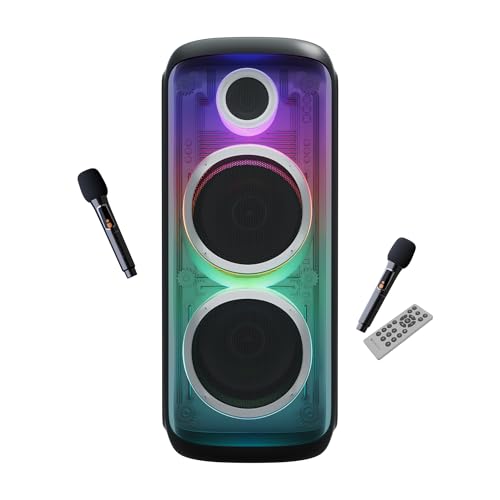
The cheapest speaker here that can genuinely carry a room full of people rather than just a living room. It undercuts every rival with a wireless mic already in the box, and the trade you accept is a short runtime and boAt's bass-forward tuning, which muddies acoustic tracks near the top of the dial.
Output90W RMS
Playtime6 hrs
Microphone1× UHF wireless
LightsRGB, app-controlled
Karaoke auto-tuner nudges pitch live — gimmicky, but flattering
Playtime is rated at 60% volume; expect nearer four hours loud
Pairs to a second unit over TWS, and takes USB or AUX input
Nothing else at this price moves as much air, and nothing else gives you a proper floor-standing cabinet for less than a mid-range phone costs. It is mains-powered only, so treat it as a hall and terrace speaker rather than a portable one — and the treble gives up detail long before the bass does.
Output160W
Drivers2× 25.4cm full-range
Bluetoothv5.3
DisplayLED panel + RGB
Two 6.3mm mic sockets and a guitar input, all of them wired
Four EQ presets, plus USB and microSD playback without a phone
Links to a second Party Fyre over TWS for wider coverage
Our pick for most people: the cheapest speaker here that does everything a house party actually needs — enough output for a terrace, a cordless mic you do not have to buy separately, and a guitar socket. What you give up is the refinement and weather sealing of the JBL and Sony picks.
Output160W RMS
Playtime6 hrs
Microphone1× UHF wireless
InputsGuitar, AUX, USB
UHF beats the Bluetooth mics rivals ship — no lag while singing
Matches the mains-only Zebronics on paper while running off battery
Auto-tuner and echo levels are adjustable in the app, not fixed
The loudest spec sheet in this guide by a wide margin, and the only removable battery pack — buy this when the party has no power socket anywhere near it. Read the wattage as peak rather than RMS, and expect a cabinet heavy enough to need two hands.
Output450W peak
Battery27,000mAh removable
Drivers6-driver array
RatingIPX6 splash-proof
Two woofers, two mid-range drivers and two tweeters, for near-360° spread
Wireless karaoke mic included, plus neon light bars down both sides
DSP holds clean to roughly 80% of the dial, then audibly compresses
Half the claimed wattage of the boAt and Blaupunkt picks, and still the one that sounds best with the dial up — JBL's tuning and cabinet control matter more than the number on the box. The light show is the most convincing here, and the battery is a user-swappable pack rather than sealed in.
Output100W RMS
Playtime15 hrs
Drivers13.5cm + 2 tweeters
RatingIPX4 splash-proof
Auracast links two Encore 2 units into a true stereo pair
Wireless mic supplied; a guitar plugs straight into the back
Spare JBL Battery 200 packs sell separately — swap, do not recharge
The only pick you can leave out in the rain and stand in the sand without thinking about it, and the longest runtime in the guide. Sony's ULT button is a two-stage bass lift that earns its keep outdoors, where low frequencies thin out faster than anything else in the mix.
Output120W
Playtime30 hrs
RatingIP67 dust + water
Quick charge10 min → 3 hrs
Party Connect chains several Sony speakers across a larger space
Mic and guitar inputs on the back, with a shoulder strap supplied
Lighting patterns and EQ are configured in Sony's Music Center app
Buy this if you want a speaker that plays music well rather than one that powers a dance floor: the three-way layout and rear-facing driver make it the most accurate thing here. No lights, no mic socket and the weakest sealing on the page — the wrong tool for a pool party.
Output80W
Playtime20+ hrs
Bluetoothv5.0
Weight4.9kg
Analogue bass and treble knobs on the top plate, no app needed
Guitar-style leather carry strap instead of a moulded plastic handle
USB-A port on the back will top up a phone while it plays
The most complete speaker in this guide, and the most expensive. It goes louder than everything bar the Blaupunkt, survives being dunked rather than merely splashed, and outlasts a full day of use. The only real arguments against it are the price and the total absence of a karaoke input.
Output210W plugged in
Playtime28 hrs (34 boosted)
RatingIP68 dust + water
Drivers7-driver array
Dual 5-inch woofers with three passive radiators handle the low end
The 99Wh pack doubles as a power bank while music is playing
Roughly a kilogram lighter than the Boombox 3 it replaces
The single most abused number in this category. RMS is continuous power a speaker can actually sustain; peak or PMPO is an instantaneous figure that can be three to five times higher and means almost nothing. A 100W RMS JBL will out-shout a 450W peak cabinet. If the listing does not say RMS, assume it is not.
02
Battery or mains — where will it stand?
Cheap floor-standing DJ speakers such as the Party Fyre 510 have no battery at all, which is fine for a hall with sockets and useless on a rooftop or a beach. Battery models here range from 6 hours to 30 hours, and every one of those figures is quoted at partial volume. Halve it for real party levels.
03
Microphone: UHF, wired, or none at all
If karaoke matters, the mic type decides the experience. A UHF wireless mic has no perceptible delay and works across a room; a Bluetooth mic adds latency you will hear as an echo while singing; a wired 6.3mm mic is lag-free but tethers the singer. Marshall and the Boombox 4 have no mic input at all.
04
Weather sealing, read properly
The digits mean different things. IPX4 survives splashes, IPX6 handles jets of water, IP67 and IP68 add dust sealing and full immersion. An unrated speaker on a poolside table is a gamble. If it will live outdoors or travel to a beach, IP67 upwards is the only safe bracket.
05
Weight, handles and wheels
Party speakers get heavy fast, and the specification sheets bury it. The Tufton is 4.9kg with a strap and travels easily; a 450W boombox or a trolley cabinet wants two people or a set of wheels. Decide now whether this speaker lives in one room or moves to a different venue every month.
06
Pairing, inputs and the ecosystem
One speaker rarely covers a large space evenly. Auracast (JBL), Party Connect (Sony) and generic TWS all let you add a second unit, but only between compatible models — you cannot pair a boAt to a JBL. Check for AUX, USB and a guitar socket too if a live instrument is ever involved.
Explained
Types of Party Speaker
“Party speaker” on a retail listing covers at least five different products, and search results mix them freely — a mains-only DJ cabinet sits beside a battery boombox under the same keyword. What separates them is not price but power source, whether there is a microphone channel, and whether the design prioritises volume or tonal balance. Here is how the categories differ.
01
Portable party speakers
The PartyBox and PartyPal class: a battery, a carry handle, an RGB light show and a mic input, in a box you can lift alone. Output runs 90–250W RMS. This is the default choice for house parties, terraces and small functions, and five of our eight picks sit here.
02
Trolley and floor-standing DJ speakers
Tall two-way cabinets with 10-inch or 12-inch drivers, usually mains-only, often on castors. They move far more air per rupee than anything portable — the Party Fyre 510 is the example here — but you need sockets, floor space and no intention of carrying them upstairs.
03
Boomboxes, or “music boxes”
Wide, handle-first cabinets built around long battery life and sound quality rather than lights and karaoke. The JBL Boombox 4 and Marshall Tufton are the archetypes. They usually beat party speakers on tonal balance and weather sealing, and lose on sheer volume per rupee.
04
Karaoke-first speakers
Built around the microphone rather than the music: real-time auto-tune, echo and reverb controls, two mic channels, sometimes a recording function. The boAt PartyPal line and Zebronics' karaoke models lead this group in India. Vocal clarity is prioritised over deep bass extension.
05
Home speakers pressed into party duty
Mains-powered lifestyle speakers such as the Marshall Acton and Stanmore, or a soundbar with a subwoofer. They sound better than any party speaker at living-room volume and simply run out of headroom once a crowd arrives. Good for gatherings, wrong for dancing.
06
Multi-speaker arrays
Not a product type so much as a strategy: two or more linked units covering a large space more evenly than one loud speaker ever can. Auracast, Party Connect and TWS all do it. Two mid-priced speakers usually beat one expensive one for coverage — though not for bass.
Under the Hood
How party speakers actually work
Almost every confusing thing about this category comes from one mismatch: the number manufacturers print largest is amplifier power, and the thing buyers care about is perceived loudness. The two are related, but not remotely proportionally. Understanding the mechanism makes spec sheets readable and explains why the cheapest speaker with the biggest number is usually the worst buy on the page.
Decibels, distance, and why 450W is not five times louder
Loudness does not scale with wattage. Doubling amplifier power buys roughly 3dB of extra sound pressure, and it takes about 10dB before most people call something “twice as loud”. So going from 90W to 450W — five times the power — is worth around 7dB, a clear step up but nothing like five times the volume. Distance works against you just as steeply: sound pressure drops about 6dB every time you double the distance from the cabinet. That is why a second speaker placed across a room usually beats one speaker turned up further.
RMS versus peak: how the big number on the box is made
RMS power is what the amplifier can deliver continuously without the signal collapsing. Peak power is the brief maximum it can pass on a transient, and PMPO is a marketing figure with no agreed definition at all — it is routinely quoted at three to five times RMS. Two speakers advertising the same wattage can therefore differ enormously: the 100W RMS PartyBox Encore 2 plays cleaner at high volume than several 200W-plus peak-rated rivals, because the amplifier is not being asked to do anything it cannot sustain.
Woofers, tweeters and passive radiators
A party speaker splits the signal by frequency. The woofer — typically 13cm to 25cm here — moves the air that produces bass, and cone area matters more than watts for how deep it goes. Tweeters handle detail above roughly 2kHz and are what keeps vocals intelligible once the bass is loud. A passive radiator is an undriven cone tuned to resonate with the woofer, adding low-end output without extra amplifier power or a port; the Boombox 4 uses three of them alongside its two woofers, which is how a portable cabinet reaches that low.
Wireless microphones and multi-speaker linking
Karaoke lives or dies on latency. A UHF mic transmits on a dedicated radio band with delay in the low single-digit milliseconds, which is inaudible. A Bluetooth mic runs through the same codec path as music and can add 100ms or more — enough that you hear your own voice late and stop singing in time. Speaker-to-speaker linking has the same split: Auracast, built into Bluetooth 5.2 and later, broadcasts one stream to many receivers and has replaced JBL's older PartyBoost, while Sony's Party Connect and generic TWS pairing remain brand-locked.
Our Method
How we test & rank party speakers
Every speaker here is scored on five factors: sustained RMS output in watts rather than the peak or PMPO figure on the box; distortion between 80% and 100% of the volume dial, which is where cheap amplifiers fall apart and where a party actually lives; real battery life in hours against the manufacturer's own stated test volume, since a six-hour rating measured at 60% is not a six-hour party; microphone latency and type — UHF, Bluetooth or wired — because karaoke is the reason half these speakers sell in India; and portability and sealing, meaning weight in kilograms, handles or castors, and the IP rating. We weight the first three hardest, because a speaker that cannot hold its output cleanly for an evening has failed at its only job.
Rankings combine hands-on listening with these and comparable models, manufacturer specifications and published driver configurations, and verified owner reviews across marketplaces — with particular attention to reports from six months and later, since battery degradation and mic-pairing faults are the two complaints that surface after launch rather than at it. Prices come from the live Amazon.in listing on the day of publication and are rechecked at every update. Nopturnia earns an affiliate commission on qualifying purchases, but that never changes where a speaker lands in these rankings; our overall recommendation here is the third-cheapest product on the page.
Our Recommendation
The best buy for most people is the boAt PartyPal 390 Plus
At ₹13,999 it is neither the cheapest nor the most capable speaker on this page,
and it is still the one we would spend our own money on. It is the lowest price at which
you get all four things an Indian house party needs at once — genuine 160W RMS
output, a UHF wireless mic in the box rather than a ₹3,000 accessory, a guitar
input, and a battery so the speaker can move to the terrace. The JBL PartyBox Encore 2
sounds clearly better and the Boombox 4 is a better product outright, but they cost
1.8× and 3.2× as much. Every other pick wins its own category:
› Loudest for the money: Zebronics Party Fyre 510 — ₹9,999, if a mains socket is never a problem
› Tightest budget: boAt PartyPal 230 — ₹6,999 with a cordless mic already included
› Best sound and light show: JBL PartyBox Encore 2 — cleaner at full volume than anything cheaper here
› No socket anywhere: Blaupunkt Atomik Knightz 45K — a 27,000mAh pack you can swap out
› Rain, sand and pools: Sony ULT Field 7 — IP67 sealing and 30 hours between charges
› Listening, not dancing: Marshall Tufton — the most accurate speaker in the guide
› Money no object: JBL Boombox 4 — the most complete speaker here, at ₹44,999
For a living room or a small terrace with 10–15 people, 60–100W RMS is genuinely enough. For 30–50 people indoors, or any outdoor gathering, 150–250W RMS gives you headroom so the speaker is not distorting at full volume all night. Beyond that you are buying for a large hall or a wedding, and two linked speakers will cover the space better than one bigger cabinet. Always compare RMS figures, never peak.
No, and the gap is where most of the marketing happens. RMS is continuous power the amplifier can sustain; peak is a momentary maximum, often quoted at three to five times the RMS figure; PMPO has no standard definition whatsoever. A 100W RMS speaker will comfortably out-perform a 450W peak one. If a listing quotes a very large number without the letters RMS beside it, treat it as a peak figure and mentally divide by three.
A wired 6.3mm mic is lag-free and perfectly good if the singer stands next to the speaker. A UHF wireless mic, like the ones bundled with the boAt PartyPal models, has no audible delay and lets people move around the room, which is what most buyers actually want. Avoid Bluetooth microphones for karaoke: the codec adds latency you hear as an echo, and it makes singing in time surprisingly difficult.
Yes, but only between compatible models. JBL uses Auracast on its current PartyBox and Boombox range, Sony uses Party Connect, and most Indian brands use generic TWS pairing. None of these talk to each other, so you cannot pair a boAt speaker to a JBL. If you think you will add a second unit later, buy both from the same brand and generation — even within one brand, older PartyBoost models will not link to newer Auracast ones.
They are louder for the money and worse at everything else. A ten-inch floor-standing cabinet at ₹9,999 moves far more air than a portable at the same price, which is why they dominate Indian function and wedding use. But they are usually mains-only, they are heavy, and the tuning is coarser. If the speaker needs to travel or run without a socket, buy portable and accept fewer watts.
It is the colloquial name for a boombox: a wide, handle-carried cabinet built around battery life and sound quality rather than light shows and karaoke. The JBL Boombox 4 and Marshall Tufton in this guide are the two clearest examples. Compared with a party speaker of the same price they generally sound more balanced and survive weather better, and they go less loud per rupee.
Only the properly rated ones. IPX4 handles splashes and a light drizzle, IPX6 survives jets of water, and IP67 or IP68 adds dust sealing plus full immersion — the Sony ULT Field 7 and JBL Boombox 4 are the two picks here you could genuinely leave poolside. An unrated speaker should never be left out overnight, and no rating covers direct sun on a battery for hours.
It depends what you are buying. At ₹24,999 the PartyBox Encore 2 costs nearly double the ₹13,999 boAt PartyPal 390 Plus and claims less power, so on paper it looks a poor deal. What the money buys is cleaner sound at high volume, a far better light show, a replaceable battery and long-term app and firmware support. If the speaker is mainly for karaoke and volume, the boAt is the smarter purchase.
Roughly half the advertised figure at party volume. Manufacturers quote runtime at moderate output — boAt states its six-hour figure at 60% volume, and JBL and Sony test similarly — while lights, a connected mic and heavy bass all draw extra current. Expect three to four hours from a six-hour rating, and around fifteen from the Sony's thirty. A speaker with a removable pack, like the Blaupunkt, sidesteps the problem entirely.
All the audio gear we track, in one place
Live prices, discounts and 90-day price history across speakers, headphones and earbuds — search it, filter it by price and spec, and save what you're watching.




 boAt
boAt