A 100-inch screen for the price of a 43-inch TV. Eight projectors under ₹20,000 ranked on the specs that actually decide picture quality — native resolution, measured ANSI brightness, and whether Netflix will stream in HD at all.
Twenty thousand rupees buys a 43-inch television. It also buys a projector that throws a 100-inch image on your living room wall — and in 2026, for the first time, it buys one that is genuinely good. Native 1080p panels, licensed Netflix apps and measured brightness above 1000 ANSI have all crossed below the ₹20,000 line in the last eighteen months.
The catch is that this is also the price band where spec sheets lie hardest. "10,000 lumens" on the box usually means about 300 ANSI in your room. "4K supported" often sits on top of a 720p panel. And an uncertified smart platform will stream Netflix at 480p no matter how good the optics are. We picked eight projectors from ₹9,490 to ₹18,999 that survive all three tests, then ranked them on what they actually deliver. If your budget stretches further, our wider guide to the best home projectors in India covers 4K and premium DLP models up to ₹71,000.
Side-by-side
Projector Comparison — Under ₹20,000
Scroll right on smaller screens to see all columns.
Listed cheapest first. Click Amazon to buy at the listed price.
Best Budget01 / 08
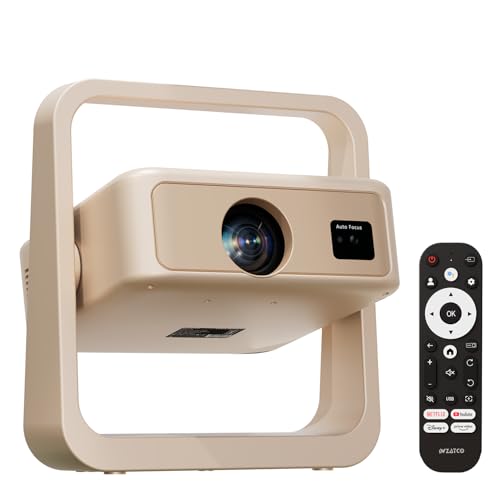
E GATE
E GATE Atom 4X+
4.2 / 5₹9,490
The cheapest projector here that still gives you a genuine 1920×1080 panel rather than a 720p chip upscaling a Full HD signal — the single biggest quality jump under ₹10,000. E GATE quotes a measured 400 ISO lumens instead of an inflated LED figure, which is refreshingly honest and enough for a fully darkened room at 100 inches. Android 12 runs Netflix and Prime natively, and a bundled Live TV app adds 100+ free channels.
ResolutionNative 1080p
Brightness400 ISO lumens
PlatformAndroid 12
Contrast6000:1
Genuine native 1080p panel — not a 720p chip upscaling Full HD input
Rotatable FlexAngle body projects onto walls and ceilings from any position
HDMI ARC + CEC lets you drive a soundbar from the projector remote
A big, bright picture for very little money, with the caveat that the headline 14,000-lumen figure is an LED-lumen marketing number — in practice expect performance in the 250–300 ANSI range, which still comfortably beats every sub-₹10,000 option. The real wins are a 10,000:1 contrast ratio that keeps dark scenes from turning grey, and a rotatable body with auto focus and auto keystone so setup takes seconds.
ResolutionNative 1080p
Contrast10,000:1
ConnectivityWiFi 6 / BT 5.2
Lamp Life50,000 hrs
10,000:1 contrast keeps night scenes from washing out to grey
Dual-band WiFi 6 and Bluetooth 5.2 for lag-free casting and wireless audio
50,000-hour lamp life — roughly 20 years at three hours a night
The point where projectors stop being a compromise. 750 ANSI lumens is a real, comparable measurement — roughly triple what the sub-₹12,000 machines deliver — and it is the first pick here that stays watchable with a lamp on or curtains half-drawn. The 20W speaker is genuinely loud enough to skip a soundbar for casual viewing, and WiFi 6 keeps a 4K stream from stuttering.
ResolutionNative 1080p
Brightness750 ANSI
Audio20W
ConnectivityWiFi 6
750 ANSI lumens — a measured figure, not an LED-lumen marketing number
20W speaker system is loud enough to skip a soundbar for casual viewing
Auto focus with 4D keystone corrects for corner and off-axis placement
1000 ANSI lumens for under ₹17,000 is the best brightness-per-rupee ratio in this guide, and the Widevine L1 certification on WZATCO’s Whale OS means Netflix and Prime actually stream at HD rather than being downgraded to 480p — the trap that catches most uncertified budget projectors. The sealed optical engine keeps dust off the LCD panel, which is the usual cause of the grey blotches that appear on cheap projectors after a year.
ResolutionNative 1080p
Brightness1000 ANSI
DRMWidevine L1
HDRHDR / HLG
Widevine L1 certified — Netflix and Prime stream in HD, not downgraded 480p
Sealed optical engine blocks the dust ingress that causes grey blotches
HDMI ARC passes audio back to a soundbar over a single cable
Officially Netflix Certified, which matters more than the spec sheet suggests: it means the Netflix app is licensed and pre-installed rather than side-loaded, so it will not stop working after an update. Android 13 via Whale TV covers Prime Video, YouTube and JioHotstar out of the box, and obstacle avoidance plus auto keystone mean you can drop it on a coffee table and start watching without touching a setting.
ResolutionNative 1080p
PlatformAndroid 13
CertificationNetflix
Audio5W built-in
Officially Netflix Certified — a licensed app that survives updates
Obstacle avoidance auto-shifts the image away from fans and shelves
Adjustable-angle chassis projects upward without stacking books under it
The one to buy if the projector moves around — bedroom tonight, terrace on the weekend, a friend’s place next month. Official Google TV with a licensed Netflix app, Dolby Audio tuning and a Bluetooth speaker mode make it a genuinely self-contained box. The trade-off is honest and worth understanding: at 200 ANSI it is the dimmest pick here, so it needs a properly dark room. Within that constraint the picture is excellent.
ResolutionNative 1080p
Brightness200 ANSI
PlatformGoogle TV
AudioDolby Audio
Doubles as a Bluetooth speaker with Dolby Audio when the lamp is off
Official Google TV with a licensed Netflix app and Google Cast built in
STR8 auto keystone (±30°) plus obstacle avoidance for instant setup anywhere
The most complete projector you can buy under ₹20,000. 1200 ANSI lumens is the highest measured brightness in this guide and enough for evening viewing with a lamp on; official Google TV with Widevine L1 means every streaming app runs licensed and at full resolution. Add HDR10+ with a 99% colour gamut, a sealed optical engine, WiFi 6, Bluetooth 5.4 and a full automatic setup suite, and nothing else in the price band matches it feature for feature.
ResolutionNative 1080p
Brightness1200 ANSI
PlatformGoogle TV
HDRHDR10+
1200 ANSI lumens — the brightest measured figure in this guide
Official Google TV with Widevine L1 across Netflix, Prime, Hotstar and Zee5
Auto focus, auto keystone, obstacle avoidance and auto screen-fit in one pass
Built for the biggest wall in the house. Crossbeats rates the Solis to a 300-inch image — the largest here — and backs it with 1000 ANSI lumens and HDR10+ so the picture does not fall apart as it scales. Google TV on Android 14 opens the full Play Store rather than a locked-down app list, and Dolby surround processing with Google Assistant voice search round out a projector that behaves much more like a smart TV than a beamer.
ResolutionNative 1080p
Brightness1000 ANSI
Max Screen300"
HDRHDR10+
Scales to a 300-inch image — the largest projection in this guide
Full Google Play Store access, not a locked-down built-in app list
Kids Mode with content filters and multiple personalised user profiles
The only brightness figure worth comparing is ANSI. Under ₹20,000 the real range is 200–1200 ANSI. Treat any "10,000 lumens" claim as an LED-lumen figure worth roughly 250–350 ANSI, and compare like with like.
02
Native Resolution
Insist on native 1080p — a real 1920×1080 panel. "1080p supported" or "4K supported" describes the input signal only; the panel underneath may be 720p or lower. All eight picks here are native 1080p.
03
Widevine L1 / Netflix Certification
Without L1 certification, Netflix and Prime deliberately stream at 480p regardless of your panel. Look for "Widevine L1", "Netflix Certified" or "Official Google TV" — anything else means a side-loaded app that can break on update.
04
Throw Distance & Room Size
Most of these are standard-throw at roughly 1.2:1–1.5:1, so a 100-inch image needs about 2.6–3.3m of clearance behind the lens. Measure the room first — it decides your maximum screen size more than any spec does.
05
Auto Focus & Keystone
Auto focus with 4D or ±30° auto keystone turns a ten-minute alignment ritual into a two-second one. Obstacle avoidance and auto screen-fit, found on the Yuva Infinity and Beem 570, go further and shift the image around fans and shelves.
06
Audio Output & HDMI ARC
Built-in speakers sit behind a cooling fan, so dialogue suffers at volume. A 20W system (Lumex Prism) handles casual viewing; for film nights you want HDMI ARC to drive a soundbar over one cable, or at minimum Bluetooth audio out.
Explained
Types of home projector
"Projector" covers several distinct designs, and the right one depends on how much room depth you have, whether the unit stays put, and how much you care about black levels. Three things separate them: throw distance, portability, and the imaging technology inside. Here is how the main types compare.
01
Standard-throw LCD
The dominant type under ₹20,000. A single LCD panel with an LED lamp, sitting 2.5–3.5m back from the wall. Cheapest per lumen and per inch of screen — every pick in this guide is one — but it needs the room depth.
02
Short-throw
Projects a 100-inch image from roughly 1–1.5m away, so it works in small rooms and nobody walks through the beam. You pay a premium for the optics — genuine short-throw units generally start above ₹20,000.
03
Portable / mini
Battery-friendly, palm-to-lunchbox sized, and designed to move between rooms or outdoors. Brightness is the trade-off — typically 150–250 ANSI, so a dark room is mandatory. The Lumio Arc 5 is the pick here.
04
Smart vs dumb
A smart projector runs Google TV or Android with apps built in. A "dumb" one is just a light engine needing an external Fire Stick or Chromecast. Smart is standard in this band, but only certified smart platforms stream in HD.
05
Sealed vs open optical engine
An open engine draws dust onto the LCD panel, which shows up as permanent grey blotches after a year or two. A sealed engine — on the Yuva Infinity, Yuva Vibe Pro and Lumio Arc 5 — is the single best predictor of how the picture ages.
06
DLP vs LCD
Almost everything under ₹20,000 is single-panel LCD: brighter colours for the money, slightly softer blacks. DLP delivers better contrast and no convergence error but costs more — it appears in this category from around ₹30,000 up.
Under the Hood
How projector technology works
A projector is a lamp, a panel and a lens. Everything in the spec sheet describes one of those three, and once you know which, the marketing numbers become much easier to read.
Brightness: ANSI vs LED lumens
ANSI lumens is a standardised measurement: nine points across a projected white field, averaged, in a controlled room. It is comparable between brands. LED lumens (sometimes "light source lumens" or just "lumens") measures the raw output of the LED chip before it passes through the panel, lens and colour wheel — typically three to five times higher than what reaches your wall. A projector advertising 14,000 LED lumens and one advertising 300 ANSI may be the same machine. When a brand publishes an ANSI figure, that is a signal in itself: it means the number survives comparison.
Panels: LCD, DLP and LCoS
Under ₹20,000 you are buying single-panel LCD: white light passes through one liquid-crystal panel carrying the image. It is cheap, bright and colour-accurate, but black is really very dim grey, so contrast is the weak point. DLP bounces light off millions of micro-mirrors for deeper blacks and no convergence error, at higher cost. LCoS is the premium hybrid found in home-cinema projectors well above this band.
Keystone, throw ratio and focus
Throw ratio is distance divided by image width — a 1.3:1 projector needs 1.3m of depth for every metre of screen width. Keystone correction digitally squares up a trapezoid image when the projector is off-centre, which costs a little resolution, so physical alignment always beats correction. Auto focus uses a small camera or time-of-flight sensor to sharpen the image on startup; combined with 4D keystone it makes placement genuinely casual.
Smart platforms and DRM
This is the spec that catches most buyers. Streaming services enforce Widevine DRM: level L1 permits full HD, level L3 caps playback at 480p. An unlicensed Android build — even one with the Netflix APK side-loaded — is L3, so a native 1080p panel gets fed a 480p stream. Official Google TV, Widevine L1 certification, or a "Netflix Certified" badge are the three labels that guarantee otherwise.
Our Method
How we test & rank projectors
Every projector in this guide is scored on the five factors that decide real-world picture quality: native panel resolution, measured brightness in ANSI lumens, contrast ratio, streaming certification (Widevine L1 / Netflix), and value for money. We deliberately discount LED-lumen claims, and we weight what a projector does in an ordinary Indian living room — ambient light, a 2.5–3.5m throw, a bare wall — over what it manages in a blacked-out test lab.
Our rankings combine hands-on impressions, manufacturer specifications, and verified owner reviews across marketplaces. Prices and availability are rechecked at each update and were verified against live Amazon India listings on 16 August 2026; they are indicative and do move. Nopturnia earns an affiliate commission on qualifying purchases, but that never changes where a projector lands in these rankings.
Our Recommendation
The best projector under ₹20,000 is the WZATCO Yuva Infinity
If we had to pick just one: the WZATCO Yuva Infinity at ₹18,990 is the only projector here that clears every bar at once — native 1080p, the highest measured brightness in the band at 1200 ANSI, official Google TV with Widevine L1, HDR10+, a sealed optical engine, and a full automatic setup suite. Nothing else under ₹20,000 matches it feature for feature. But every projector in this guide wins its own category:
› Tightest budget: E GATE Atom 4X+ — a genuine native 1080p panel at ₹9,490
› Best under ₹15,000: Crossbeats Lumex Prism — 750 ANSI and a 20W speaker
› Brightness per rupee: WZATCO Yuva Vibe Pro — 1000 ANSI and Widevine L1 at ₹16,990
Judge brightness in ANSI lumens, not the inflated "LED lumens" figure on the box. Under ₹20,000, 200–400 ANSI needs a fully darkened room; 700–800 ANSI stays watchable with curtains drawn in the evening; and 1000–1200 ANSI — the ceiling in this price band, hit by the WZATCO Yuva Infinity and Crossbeats Lumex Solis — tolerates a lamp on in the room. If a listing advertises 10,000 or 14,000 lumens, that is an LED-lumen number and typically works out to roughly 250–350 ANSI.
Yes, and it is the single most important spec on this page. "1080p supported" or "4K supported" only means the projector accepts that input signal — the actual panel may be 480p or 720p, and everything gets downscaled before it reaches your wall. Native 1080p means a real 1920×1080 panel. Every pick in this guide is native 1080p; below roughly ₹8,000 most projectors are not, which is why the budget entry here starts at ₹9,490.
Widevine is the DRM system Netflix, Prime Video and Hotstar use to protect their streams. On an uncertified projector — Widevine L3 — those apps deliberately drop to 480p, so a native 1080p panel is wasted. Widevine L1 certification, or an official "Netflix Certified" badge, means the projector is licensed for full HD playback. The WZATCO Yuva Infinity, Yuva Vibe Pro, Crossbeats Lumex Solis, Lumio Arc 5 and Portronics Beem 570 all clear this bar.
Partly. Nothing in this price band replaces a TV in a bright, sunlit room. With curtains drawn on an overcast afternoon or a single lamp on in the evening, the 1000–1200 ANSI picks — Yuva Infinity, Lumex Solis, Yuva Vibe Pro — hold up well at 100 inches. The 200–400 ANSI models need genuine darkness. A grey or ALR projector screen instead of a bare white wall buys you roughly one brightness tier for around ₹2,000–₹4,000.
A smooth, matte white wall works and is what most buyers start with. A dedicated screen improves things in two ways: a properly flat surface removes the subtle texture that softens fine detail, and a grey or ALR screen raises perceived contrast by rejecting ambient light. If your wall is textured, glossy or off-white, a ₹2,000 pull-down screen is the highest-value accessory you can add to any projector here.
Throw ratio tells you how far back the projector must sit for a given image width. Most of these are standard-throw, roughly 1.2:1 to 1.5:1, so a 100-inch diagonal (about 2.2m wide) needs roughly 2.6–3.3m of clearance. Measure your room before buying. If you cannot get 2.5m back, look at a short-throw model instead — or accept a smaller image, which also looks brighter.
Every pick here uses an LED light source rather than a traditional UHP bulb, rated at 30,000–60,000 hours. At three hours of viewing a night, 50,000 hours is over 45 years — so unlike old lamp projectors, there is no consumable bulb to replace. LEDs dim gradually rather than failing outright, and you would typically replace the whole unit long before brightness became a problem.
A ₹20,000 TV gets you roughly a 43-inch panel that works in any lighting. A ₹20,000 projector gets you 100 inches or more, but only in a darkened room. Buy the projector if you watch mostly at night, want a cinema-scale image, and can control the light; buy the TV if it is the main screen in a bright living room used all day. Many people end up with both — a modest TV for daytime and a projector for film nights.
For casual viewing, mostly yes — and the Crossbeats Lumex Prism’s 20W system is genuinely loud. But every projector here puts its speaker behind a cooling fan, so dialogue clarity suffers at volume. For film nights, connect a soundbar. The WZATCO models and the Yuva Infinity support HDMI ARC, which passes audio back down a single cable; the others need Bluetooth or a 3.5mm out.
All the home entertainment gear we track, in one place
Live prices, discounts and 90-day price history across the full catalogue — search it, filter it by price and spec, and save what you're watching.



 E GATE