Buying Guide

Best Graphics Cards
2026 · Value RTX Picks for AAA Gaming

NVIDIA has raised prices three times this year and a GDDR7 shortage has pushed street prices far past MSRP. So “best” now means best rupees per frame. Ten cards you can actually buy today, ranked for AAA gaming — from a ₹49,900 1080p entry point to the ₹6,24,399 halo card we cannot recommend.

Nopturnia Editorial
27 min read India 10 picks
Best graphics cards in India 2026 — NVIDIA RTX 50-series and AMD RDNA 4 GPUs compared

Overview

Buying a GPU in the worst pricing market since the crypto boom

A graphics card buying guide in 2026 has to start with the bad news, because the prices on this page are not typos. NVIDIA has pushed through three separate price increases this year, the most recent worth 20–30%, and the cause is not retail gouging. A global DRAM shortage — driven by AI data centres, which analysts expect to absorb as much as 70% of world memory output this year — has made the memory on a graphics card one of its most expensive components. A 3GB GDDR7 module now costs $60–70 against roughly $20 for a conventional 2GB part, and every card here carries eight to sixteen of them.

You can see the damage in the listings. The RTX 5070 launched at a $549 MSRP; on Amazon.in today the same chip runs from ₹88,920 to ₹1,16,999 depending on whose shroud is bolted to it. The RTX 5090, a $1,999 card at launch, now sells for nearly $5,000 on NVIDIA’s own store and ₹6,24,399 here. When the same silicon varies by ₹28,000 between board partners, brand loyalty has become an expensive habit.

So this guide does not rank cards by raw performance — that would simply point at the most expensive item on the page. It ranks them on rupees per frame at a stated resolution, VRAM headroom against what 2026 AAA titles actually allocate, and real availability on Amazon.in at a price we verified on the day of publication. Nine of the ten picks are GeForce RTX cards, because that is what the Indian market stocks and what DLSS 4 support argues for. The tenth is a Radeon, included because it offers 16GB of memory for ₹27,471 less than the cheapest 16GB GeForce, and pretending otherwise would not serve you.

The short version, if you read nothing else: buying now is the right call. Analysts do not expect meaningful memory relief until late 2027 and possibly 2028, so “wait for prices to fall” is a plan to not own a graphics card for two years. Buy the tier your monitor justifies, insist on 12GB or more if you are spending above ₹85,000, and ignore the halo cards.

Side-by-side

Graphics Card Comparison 2026

Scroll right on smaller screens to see all columns.

Card Price GPU VRAM Bus Best For Rating Buy
GIGABYTE GeForce RTX 5050 WINDFORCE OC 8GB graphics card
GIGABYTE RTX 5050
Best Entry Point
₹49,900 RTX 50508GB GDDR6128-bit1080p high 4.0 Amazon
ZOTAC Gaming GeForce RTX 5060 Twin Edge 8GB GDDR7 graphics card
ZOTAC RTX 5060
Best Value Overall
₹55,979 RTX 50608GB GDDR7128-bit1080p ultra 4.5 Amazon
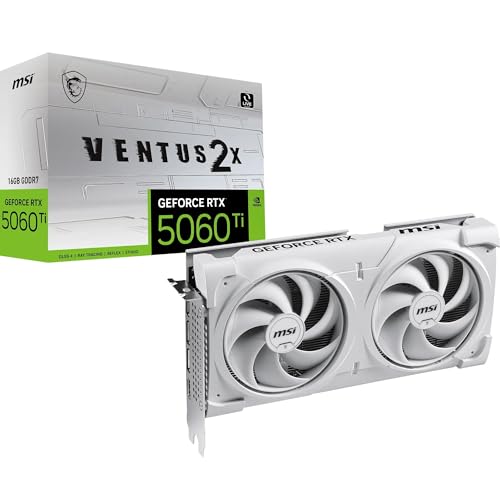
MSI GeForce RTX 5060 Ti 8G Ventus 2X OC White Plus graphics card
MSI RTX 5060 Ti 8G
Best Marginal Rupee
₹60,009 RTX 5060 Ti8GB GDDR7128-bit1080p high-refresh 4.2 Amazon
GIGABYTE Radeon RX 9060 XT Gaming 16G graphics card
GIGABYTE RX 9060 XT 16G
Best VRAM per Rupee
₹62,429 RX 9060 XT16GB GDDR6128-bit1440p value 4.4 Amazon
INNO3D GeForce RTX 5070 Twin X2 12GB GDDR7 graphics card
INNO3D RTX 5070
Best Performance per Rupee
₹88,920 RTX 507012GB GDDR7192-bit1440p ultra 4.4 Amazon
GIGABYTE GeForce RTX 5060 Ti WINDFORCE 16G GDDR7 graphics card
GIGABYTE RTX 5060 Ti 16G
Best 1440p Headroom
₹89,900 RTX 5060 Ti16GB GDDR7128-bit1440p + ray tracing 4.5 Amazon
ASUS Dual GeForce RTX 5070 12GB GDDR7 OC Edition graphics card
ASUS Dual RTX 5070
Best 1440p All-Rounder
₹97,149 RTX 507012GB GDDR7192-bit1440p ultra, quiet 4.5 Amazon
ZOTAC Gaming GeForce RTX 5070 Ti Solid SFF OC 16GB graphics card
ZOTAC RTX 5070 Ti
Best Entry 4K
₹1,47,229 RTX 5070 Ti16GB GDDR7256-bit1440p max / 4K 4.4 Amazon
ZOTAC Gaming GeForce RTX 5080 Solid CORE 16GB GDDR7 graphics card
ZOTAC RTX 5080
Best 4K Flagship
₹1,85,849 RTX 508016GB GDDR7256-bit4K ultra 4.3 Amazon
ASUS TUF Gaming GeForce RTX 5090 32GB GDDR7 graphics card
ASUS TUF RTX 5090
Halo — No Compromise
₹6,24,399 RTX 509032GB GDDR7512-bit4K max / workstation 3.8 Amazon

In-Depth Reviews

Graphics Card Reviews — All 10 Picks

Click Amazon to buy at the listed price.

Best Entry Point 01 / 10
GIGABYTE GeForce RTX 5050 WINDFORCE OC 8GB graphics card GIGABYTE

GIGABYTE GeForce RTX 5050 WINDFORCE OC 8GB

4.0 / 5 ₹49,900

The cheapest way into Blackwell and DLSS 4, and the only card here that still fits a ₹50,000 budget. It is the one RTX 50-series part that kept GDDR6 instead of moving to GDDR7 — which is precisely why it undercuts the RTX 5060 by ₹6,079 in a market where memory is the expensive ingredient. At 1080p with DLSS 4 quality it holds 60fps in current AAA titles; asking for native ultra is asking too much.

ChipRTX 5050
Memory8GB GDDR6
Bus128-bit · 320 GB/s
Boost2587 MHz
  • GDDR6 rather than GDDR7 caps it at 320 GB/s against the RTX 5060’s 448 GB/s — the gap widens as textures get heavier
  • 130W board power runs happily on a 450W supply with a single 8-pin, so it drops into most prebuilts without a PSU swap
  • DLSS 4 with Multi Frame Generation is the entire value proposition here — in titles that lack it, this card feels a tier slower
Best Value Overall 02 / 10
ZOTAC Gaming GeForce RTX 5060 Twin Edge 8GB GDDR7 graphics card ZOTAC

ZOTAC Gaming GeForce RTX 5060 Twin Edge 8GB

4.5 / 5 ₹55,979

The card we would actually buy for a new 1080p gaming build in 2026. GDDR7 at 28 Gbps lifts it to 448 GB/s on the same 128-bit bus the RTX 5050 uses, and 3,840 CUDA cores are enough for ultra settings at 1080p in nearly everything. ZOTAC also backs it with a five-year warranty after registration — no other card in this guide comes close on cover, and in a market where you will keep a GPU longer than you planned, that matters.

ChipRTX 5060
Memory8GB GDDR7 28 Gbps
Bus128-bit · 448 GB/s
CUDA cores3,840
  • Five-year warranty on registration — the longest cover here, against the two to three years everyone else offers
  • ₹14.58 per CUDA core makes it the second-best raw silicon-per-rupee buy on this page
  • Two-slot SFF-ready cooler at 145W: it fits ITX cases that will not take the triple-fan cards further down
Best Marginal Rupee 03 / 10
MSI GeForce RTX 5060 Ti 8G Ventus 2X OC White Plus graphics card MSI

MSI GeForce RTX 5060 Ti 8G Ventus 2X OC White Plus

4.2 / 5 ₹60,009

Roughly 14% faster than the RTX 5060 across a hundred-plus games, for ₹4,030 more. That is the best marginal rupee in this entire guide — 7% more money for 14% more performance — and at ₹13.02 per CUDA core it is the cheapest silicon on the page. The catch is the 8GB buffer: this is a chip with 1440p ability and a 1080p memory allowance, so buy it for high-refresh 1080p and accept that 1440p ray tracing is not its job.

ChipRTX 5060 Ti
Memory8GB GDDR7 28 Gbps
Bus128-bit · 448 GB/s
Boost2602 MHz
  • ₹13.02 per CUDA core — the best raw price-per-shader ratio of all ten cards here
  • The Gen5 x16 slot connector only wires eight lanes, so on an older PCIe 3.0 board you give up a few percent
  • 8GB is the hard limit: in RT-heavy 1440p the 16GB version of this same chip pulls away by up to 40%
Best VRAM per Rupee 04 / 10
GIGABYTE Radeon RX 9060 XT Gaming 16G graphics card GIGABYTE

GIGABYTE Radeon RX 9060 XT Gaming 16G

4.4 / 5 ₹62,429

The only card on this page that breaks the pricing logic of the rest, and the reason it earns a slot in an otherwise RTX-focused guide: 16GB of VRAM for ₹62,429, when the cheapest 16GB GeForce here costs ₹89,900. That is ₹3,902 per gigabyte against ₹5,619. Raster performance lands between the RTX 5060 and 5060 Ti, so you are not giving up frames — you are trading DLSS breadth and ray-tracing headroom for memory you will still be using in three years.

ChipRadeon RX 9060 XT
Memory16GB GDDR6
Bus128-bit · 320 GB/s
ArchitectureRDNA 4
  • ₹3,902 per gigabyte of VRAM — 31% cheaper per GB than the closest 16GB GeForce
  • FSR 4 has closed most of the visual gap to DLSS 4, but ships in far fewer titles — check your own library first
  • Ray tracing remains roughly a tier behind NVIDIA; if RT is a priority, the ₹89,900 RTX 5060 Ti 16G is the safer buy
Best Performance per Rupee 05 / 10
INNO3D GeForce RTX 5070 Twin X2 12GB GDDR7 graphics card INNO3D

INNO3D GeForce RTX 5070 Twin X2 12GB

4.4 / 5 ₹88,920

The cheapest RTX 5070 on Amazon.in, and the clearest illustration of how little board-partner branding is worth right now. This is the same GPU that GIGABYTE sells in AERO trim for ₹1,16,999 — ₹28,079 more for a different shroud and a slightly better cooler. The 192-bit bus and 672 GB/s put it half again ahead of anything below it here, and 6,144 CUDA cores make 1440p ultra a genuine target rather than an aspiration.

ChipRTX 5070
Memory12GB GDDR7 28 Gbps
Bus192-bit · 672 GB/s
CUDA cores6,144
  • 672 GB/s of bandwidth — 50% more than every 128-bit card above it, which is what 1440p actually needs
  • The identical chip sells for ₹1,16,999 in a fancier shroud; you are paying for plastic, not frames
  • Twin X2 is the loudest 5070 cooler here under sustained load — the trade you make for the ₹8,229 saving
Best 1440p Headroom 06 / 10
GIGABYTE GeForce RTX 5060 Ti WINDFORCE 16G GDDR7 graphics card GIGABYTE

GIGABYTE GeForce RTX 5060 Ti WINDFORCE 16G

4.5 / 5 ₹89,900

This card and the INNO3D RTX 5070 sit ₹980 apart, and choosing between them is the single most consequential decision on this page. The 5070 is meaningfully faster in raw frames. This one has 16GB instead of 12GB and never runs out of memory. In ray-traced 1440p, where 8GB cards fall off a cliff, a 16GB buffer is worth up to 40% over its own 8GB twin — and modded, texture-heavy games punish a short buffer far more visibly than they reward a faster chip.

ChipRTX 5060 Ti
Memory16GB GDDR7
Bus128-bit · 448 GB/s
CUDA cores4,608
  • 16GB GDDR7 at ₹5,619 per gigabyte — the cheapest 16GB GeForce you can buy today
  • Priced within ₹980 of the INNO3D RTX 5070: pick this for textures and mods, the 5070 for frame rate
  • Still a 128-bit bus, so bandwidth is unchanged from the 8GB card — the win is capacity, not speed
Best 1440p All-Rounder 07 / 10
ASUS Dual GeForce RTX 5070 12GB GDDR7 OC Edition graphics card ASUS

ASUS Dual GeForce RTX 5070 12GB OC Edition

4.5 / 5 ₹97,149

The same RTX 5070 as the INNO3D, ₹8,229 dearer, and worth it if you value silence and service over the last thousand rupees. Axial-tech fans with 0dB mode stop turning entirely below roughly 55°C, so the card is genuinely inaudible on the desktop, and ASUS has the widest service network of any board partner in India — a real consideration when a replacement GPU now costs six figures. The factory overclock is worth about 2%; buy this for the cooler, not the clock.

ChipRTX 5070
Memory12GB GDDR7 28 Gbps
Bus192-bit · 672 GB/s
Boost2572 MHz OC
  • 0dB fan mode means complete silence at idle and during light load — the quietest 5070 in this guide
  • 2.5 slots and 227mm long: it clears small-form-factor cases the triple-fan 5070 variants will not
  • ASUS’s India RMA network is the practical reason to pay the premium, not the 2% factory OC
Best Entry 4K 08 / 10
ZOTAC Gaming GeForce RTX 5070 Ti Solid SFF OC 16GB graphics card ZOTAC

ZOTAC Gaming GeForce RTX 5070 Ti Solid SFF OC 16GB

4.4 / 5 ₹1,47,229

The first card here with genuine 4K credentials, and the cheapest RTX 5070 Ti on Amazon.in by ₹7,771. The 256-bit bus is the reason it matters: 896 GB/s is double what the 5060 Ti moves, and 8,960 CUDA cores paired with 16GB make maxed-out 1440p effortless and 4K with DLSS 4 entirely practical. That ZOTAC fits all of it into a two-slot SFF-ready card with a triple fan is unusual, and the reason this is the enthusiast GPU for a small build.

ChipRTX 5070 Ti
Memory16GB GDDR7
Bus256-bit · 896 GB/s
CUDA cores8,960
  • 896 GB/s on a 256-bit bus — the bandwidth step that separates a 1440p card from a 4K one
  • Two-slot triple-fan SFF design: rare at this performance tier and the reason it fits ITX cases
  • 300W board power wants a quality 750W supply; the 16-pin 12V-2x6 adapter is in the box
Best 4K Flagship 09 / 10
ZOTAC Gaming GeForce RTX 5080 Solid CORE 16GB GDDR7 graphics card ZOTAC

ZOTAC Gaming GeForce RTX 5080 Solid CORE 16GB

4.3 / 5 ₹1,85,849

The last card in this guide whose price still tracks its performance. It delivers roughly 20% more than the RTX 5070 Ti for 26% more money — not a bargain, but a coherent step, which is more than can be said for what sits above it. 10,752 CUDA cores and 960 GB/s make 4K ultra a native target rather than an upscaled one. The single real complaint is the memory: 16GB on a ₹1.86 lakh 4K flagship is the same buffer you get on a ₹89,900 card.

ChipRTX 5080
Memory16GB GDDR7 30 Gbps
Bus256-bit · 960 GB/s
CUDA cores10,752
  • Roughly 20% faster than the 5070 Ti for 26% more — the last near-linear price step in the stack
  • 16GB on a 4K flagship is the weak point; at this money a 24GB buffer would have aged far better
  • 360W and a three-slot triple-fan cooler — measure case clearance and budget a 850W supply
Halo — No Compromise 10 / 10
ASUS TUF Gaming GeForce RTX 5090 32GB GDDR7 graphics card ASUS

ASUS TUF Gaming GeForce RTX 5090 32GB

3.8 / 5 ₹6,24,399

The fastest consumer graphics card you can buy, and comfortably the worst value on this page. At ₹6,24,399 it costs ₹28.70 per CUDA core against the RTX 5060 Ti’s ₹13.02 — you pay more than double per unit of silicon. We are listing it because it is the only answer for uncompromised 4K and because 32GB at 1,792 GB/s genuinely changes the maths for local AI models and 8K editing. As a gaming purchase at this price, it is very hard to defend.

ChipRTX 5090
Memory32GB GDDR7
Bus512-bit · 1,792 GB/s
CUDA cores21,760
  • ₹28.70 per CUDA core — more than double the RTX 5060 Ti’s rate, and the worst ratio here
  • 32GB and 1,792 GB/s make it a credible workstation card: for local LLMs and 8K timelines the value case flips
  • 575W, 3.6 slots and a 1000W supply — the rest of the build costs more because of this one part

Before You Buy

7 Things to Check

VRAM — 8GB is the floor, 12GB is the safe buy

This is the specification that ages worst. 8GB still works at 1080p and will for a while, but at 1440p with ray tracing enabled it is already the limiting factor — the 16GB version of the RTX 5060 Ti can be up to 40% faster than the 8GB card built on the identical chip, purely because it stops running out of memory. Above ₹85,000, treat 12GB as the minimum and 16GB as the target.

Match the card to your monitor, not your ambition

The panel you already own decides which tier is rational. A 1080p 144Hz monitor is fully served by the RTX 5060 or 5060 Ti; buying an RTX 5080 to drive it wastes roughly ₹1.3 lakh. For 1440p aim at the RTX 5070 or 5060 Ti 16G, and for 4K nothing below the RTX 5070 Ti will hold up. Upgrading the monitor first is often the better spend.

Power supply wattage and the 12V-2x6 connector

Board power runs from 130W on the RTX 5050 to 575W on the RTX 5090. As a working rule budget a quality 550W supply for the 5050–5060, 650–750W for the 5060 Ti–5070 Ti, 850W for the 5080 and 1000W for the 5090. Transient spikes matter more than the average figure, so an old or unbranded unit at the nominal rating will trip protection under load.

Physical clearance — length, slots and case width

Cards have grown faster than cases. The RTX 5090 here occupies 3.6 slots; the RTX 5080 takes three. Check your case’s stated maximum GPU length and how many expansion slots sit below the top one. If you are building small, the two-slot ZOTAC and ASUS Dual designs on this page are the ones explicitly rated SFF-ready.

PCIe generation and lane count

The RTX 5060 and 5060 Ti use a PCIe 5.0 x8 interface in a physical x16 slot. On a current board that is invisible; on an older PCIe 3.0 motherboard the halved lane count costs a few percent, and more when a game is streaming textures because the 8GB buffer is full. If you are pairing a new card with a 2018-era board, the wider-bus RTX 5070 is the safer choice.

Upscaling support in the games you actually play

Every recommendation here assumes upscaling is on, because at these prices it is what makes the frame rates work. DLSS 4 is in far more titles than FSR 4, and Multi Frame Generation is NVIDIA-only. Before choosing the Radeon on price, check that the specific games in your library support FSR 4 rather than the older, visibly softer FSR 2.

Board-partner premium — check the same chip elsewhere

This is the easiest money you will save in 2026. The RTX 5070 in this guide costs ₹88,920 from INNO3D and ₹1,16,999 from GIGABYTE in AERO trim — the same GPU, a ₹28,079 difference. Before buying any card, search its chip name and sort by price. The cheapest variant of a faster chip almost always beats the premium variant of a slower one.

Explained

Types of graphics card

“Graphics card” covers a range that now spans ₹50,000 to more than ₹6 lakh, and the tier names do more work than the numbers suggest. What actually separates them is memory bus width, VRAM capacity and shader count — not the badge. Here are the tiers you are choosing between, and who each one is genuinely for.

Entry tier — RTX 5050 class

₹45,000–55,000, 8GB, 128-bit. Built for 1080p at high settings with upscaling on, and for esports titles at high refresh. This is the tier where GDDR6 still appears instead of GDDR7, which is how it holds the price. Adequate for AAA gaming today; the first tier that will feel dated in two years.

Mainstream 1080p — RTX 5060 / RX 9060 XT class

₹55,000–65,000, 8–16GB, 128-bit. The volume tier and where most builds should land. Handles 1080p ultra comfortably and 1440p with upscaling. The 16GB Radeon variant sits here on price while offering memory that only the ₹90,000 GeForce cards match.

The 1440p sweet spot — RTX 5060 Ti 16G / RTX 5070

₹85,000–1,00,000, 12–16GB, 128- to 192-bit. Where the guide’s central decision lives: more memory or more shaders for the same money. Both handle 1440p ultra; the 5070’s 672 GB/s wins on frame rate, the 5060 Ti 16G’s larger buffer wins on ray tracing and mods.

Enthusiast — RTX 5070 Ti / RTX 5080

₹1.45–1.90 lakh, 16GB, 256-bit. The first tier with the bandwidth for native 4K rather than upscaled 4K. A 256-bit bus is the dividing line: everything below it is a 1440p card being asked to do 4K, everything at or above it was designed for the resolution.

Halo and prosumer — RTX 5090

₹6 lakh and up, 32GB, 512-bit. Bought for uncompromised 4K, for professional rendering, or for running local AI models where 32GB of fast memory has no cheaper equivalent. As a pure gaming purchase at 2026 prices, the cost per frame is roughly double the mainstream tier.

Board-partner variants — the same chip, different prices

Every chip ships in several versions. Base coolers (ZOTAC Twin Edge, GIGABYTE WINDFORCE, MSI Ventus, ASUS Dual) are two-fan and quiet enough. Premium lines (AORUS, ROG, Gaming Trio) add larger heatsinks, RGB and a factory overclock worth 2–3% — for premiums that this year have reached ₹28,000 on a single chip.

Under the Hood

How a modern GPU actually works

Graphics card spec sheets are unusually easy to misread, because the numbers printed largest — core counts and boost clocks — are only comparable within a single generation, while the number that most often decides whether a game runs well is printed small. Here is what each specification is actually telling you.

CUDA cores, clocks and why they only compare within a generation

A CUDA core is a small parallel arithmetic unit; a modern GPU has thousands running the same shader program over different pixels. Within one generation, core count scales almost linearly with performance — the RTX 5070’s 6,144 cores really are about a third faster than the 5060 Ti’s 4,608. Across generations the comparison collapses, because each generation changes what a core does per clock. A Blackwell core is not an Ada core, so counting them against an RTX 40-series card tells you very little.

Memory: GDDR7, bus width, and the bandwidth that decides 4K

Bandwidth is bus width ÷ 8 × memory speed, and it is the specification that separates the tiers on this page. A 128-bit bus with 28 Gbps GDDR7 gives 448 GB/s; the same memory on a 256-bit bus gives 896 GB/s. That is why the RTX 5070 Ti handles 4K and the RTX 5060 Ti, which has the identical memory type, does not — at 4K there are four times as many pixels to feed, and a narrow bus starves first. GDDR7 also matters in itself: the RTX 5050 and the RX 9060 XT both use older GDDR6 and land at 320 GB/s despite the same bus width as the 448 GB/s RTX 5060.

VRAM capacity is a cliff, not a slope

Bandwidth degrades gracefully; capacity does not. While a game’s working set fits in VRAM, frame times are steady. The moment it does not, the card starts fetching textures across the PCIe bus from system memory and frame times spike into visible stutter — not a smaller average frame rate, but a juddering one. This is why an 8GB and a 16GB card built on identical silicon can differ by 40% in ray-traced 1440p, and why the capacity number deserves more weight than its position on the box suggests.

Ray tracing, RT cores and what it costs

Rasterisation approximates light with decades of clever shortcuts. Ray tracing simulates individual light paths, which is enormously more expensive — enabling it can halve frame rates even on dedicated hardware. RT cores are fixed-function units that accelerate the specific geometric test of whether a ray hits a triangle. NVIDIA is on its fourth generation of them and holds a roughly one-tier lead over RDNA 4, which is the strongest technical argument for GeForce at these prices.

DLSS 4, Multi Frame Generation, and the latency question

DLSS renders at a lower internal resolution and reconstructs the full-resolution image with a neural network; at 1440p quality mode the output is frequently indistinguishable from native. Multi Frame Generation goes further and synthesises up to three intermediate frames between two rendered ones. That multiplies the frame counter but not your input response — the game still samples your mouse at the underlying rate, and generated frames add a little latency. It is transformative for single-player AAA at 4K and the wrong tool for competitive shooters.

Board power, transients and the 12V-2x6 connector

The rated TGP is an average. Real cards draw brief transient spikes well above it — a 360W RTX 5080 can pull over 500W for microseconds, which is why an underspecified or ageing supply trips its protection and the machine reboots under load rather than failing gracefully. The 12V-2x6 connector (the revised 12VHPWR) carries up to 600W on one cable; seat it until it clicks and avoid tight bends within 35mm of the plug.

Our Method

How we rank graphics cards

Every card here is scored on five factors: rupees per frame at a stated resolution rather than raw frame rate, VRAM capacity against what 2026 AAA titles actually allocate, memory bandwidth in GB/s (bus width and memory speed together, since neither means much alone), ray-tracing and upscaling performance in the titles that use them, and thermals, acoustics and board power against what a normal Indian build can supply and cool. We weight the first two hardest, because in a market where the same chip varies by ₹28,000 between partners, the card that delivers usable performance for the least money is the one that deserves the recommendation — not the fastest one.

Rankings combine hands-on experience with these platforms, manufacturer and NVIDIA/AMD reference specifications, and verified owner reviews across marketplaces, cross-checked against independent benchmark aggregates covering a hundred-plus games rather than any single title. Prices come from the live Amazon.in listing on the day of publication and are rechecked at every update — a real constraint in this category, where a third price increase landed mid-year and board-partner variants of one chip currently span ₹28,000. Nopturnia earns an affiliate commission on qualifying purchases, but that never changes where a card lands in these rankings; our overall winner is the second-cheapest product on the page, and the most expensive one carries our lowest score.

Our Recommendation

The best buy for most people is the
ZOTAC RTX 5060 Twin Edge 8GB

At ₹55,979 it is not the fastest card here and it is not the one with the most memory — it is the one that makes sense for the most people building a gaming PC right now. GDDR7 at 448 GB/s, 3,840 CUDA cores and DLSS 4 deliver 1080p ultra in current AAA titles without asking for a power supply upgrade, and ZOTAC’s five-year warranty is the longest cover on this page at a time when you will keep a graphics card longer than you meant to. If your budget stretches, the two cards to look at are the ₹62,429 RX 9060 XT, which doubles the memory for ₹6,450 more, and the ₹88,920 INNO3D RTX 5070, which is the best raw performance per rupee we found. Every other pick wins its own category:

  • Tightest budget: GIGABYTE RTX 5050 8GB — ₹49,900 for Blackwell and DLSS 4 on a 450W supply
  • Best marginal rupee: MSI RTX 5060 Ti 8G — 14% more performance than the 5060 for 7% more money
  • Most VRAM per rupee: GIGABYTE RX 9060 XT 16G — 16GB at ₹62,429, ₹27,471 under the cheapest 16GB GeForce
  • Best performance per rupee: INNO3D RTX 5070 — ₹88,920 for 672 GB/s and 6,144 CUDA cores
  • Best 1440p headroom: GIGABYTE RTX 5060 Ti 16G — the memory buffer the 8GB cards run out of
  • Quietest 1440p card: ASUS Dual RTX 5070 — 0dB idle and the widest RMA network in India
  • Best entry to 4K: ZOTAC RTX 5070 Ti — 896 GB/s on a 256-bit bus, in a two-slot SFF card
  • Best 4K flagship: ZOTAC RTX 5080 — the last card whose price still tracks its performance
  • Fastest, at a price: ASUS TUF RTX 5090 — unbeatable and unjustifiable at ₹28.70 per CUDA core
Buy Our Pick on Amazon

FAQ

Frequently Asked Questions

A global DRAM shortage. Memory makers have shifted fab capacity toward High Bandwidth Memory for AI accelerators, which sells at far higher margins, and industry forecasts have AI data centres consuming as much as 70% of world memory output this year. GDDR7 modules for graphics cards are competing for what is left: a 3GB module now costs $60–70 against roughly $20 for a conventional 2GB part. NVIDIA has passed this through in three separate increases during 2026, the most recent worth 20–30%, and AMD has raised board-partner kit prices around 10%.
No, if you need a card now. Analysts do not expect meaningful relief from the memory shortage until late 2027 and possibly 2028, because the fix requires new fab capacity that takes years to build. Waiting is a decision to go without a graphics card for roughly two years on the hope of a correction nobody is forecasting. The rational response is to buy the tier your monitor justifies rather than stretching to the next one up, and to check board-partner pricing carefully — that is where the savings actually are today.
At 1080p, yes, with upscaling enabled. At 1440p with ray tracing it is already the bottleneck. The clearest evidence is the RTX 5060 Ti, which sells in 8GB and 16GB versions built on identical silicon: in ray-traced 1440p scenarios where the 8GB card exhausts its buffer, the 16GB model can be up to 40% faster. Below ₹60,000 an 8GB card is the only realistic option and a reasonable one. Above ₹85,000, buying 8GB in 2026 is a mistake.
They sit ₹980 apart in this guide, so it is a genuine choice rather than a budget question. The RTX 5070 has 6,144 CUDA cores and 672 GB/s against the 5060 Ti’s 4,608 cores and 448 GB/s, so it is meaningfully faster in raw frames. The 5060 Ti 16G has four more gigabytes of memory and will never stutter from a full buffer. Buy the 5070 if you want the highest frame rate at 1440p; buy the 5060 Ti 16G if you play texture-heavy or heavily modded games, or run ray tracing consistently.
As a working guide: 450–550W for the RTX 5050 and 5060, 650W for the 5060 Ti and 5070, 750W for the 5070 Ti, 850W for the 5080 and 1000W for the 5090. Quality matters more than the number on the box, because these cards draw brief transient spikes far above their rated board power — a 360W RTX 5080 can pull over 500W for microseconds. An ageing or unbranded unit at the nominal rating will trip its protection and reboot the machine under load.
It depends what you want from the number. Multi Frame Generation synthesises up to three intermediate frames between two rendered ones, so motion genuinely looks smoother on a high-refresh display and the visual result is real. What it does not do is improve input response: the game still samples your mouse at the underlying render rate, and generated frames add a small amount of latency. For single-player AAA titles at 4K it is transformative. For competitive shooters, turn it off and use DLSS upscaling on its own.
It is a more reasonable question in 2026 than it usually would be, because new prices are so inflated. The risks are the familiar ones — no warranty, unknown thermal history, and a market that has absorbed a great many ex-mining cards. Note also that our own catalogue shows new RTX 3060 12GB cards at around ₹57,800 and RTX 3050 6GB cards near ₹29,000, which makes buying a used previous generation card at anything close to those figures a poor trade. If you do buy used, insist on seeing it run a benchmark loop before paying.
Slightly, and more than you might expect. The RTX 5060 and 5060 Ti expose a PCIe 5.0 x16 physical connector but only wire eight lanes. On a PCIe 5.0 or 4.0 board that is invisible. On a PCIe 3.0 board those eight lanes deliver a quarter of the bandwidth the card expects, which costs a few percent in most games and considerably more when an 8GB buffer fills and the card starts streaming textures over the bus. On an older board, the wider-bus RTX 5070 is the safer pairing.
NVIDIA holds the technical lead in ray tracing, and DLSS 4 ships in far more titles than FSR 4 with Multi Frame Generation exclusive to GeForce — which is why nine of our ten picks are RTX cards. AMD’s answer is memory per rupee, and at the moment it is a strong one: the RX 9060 XT here offers 16GB for ₹62,429 against ₹89,900 for the cheapest 16GB GeForce. If ray tracing matters to you, or the games you play support DLSS but not FSR 4, pay the NVIDIA premium. If you want the most VRAM for the money, the Radeon is the honest answer.

All the PC components we track, in one place

Live prices, discounts and 90-day price history across the full catalogue — search it, filter it by price and spec, and save what you're watching.

Browse all PC components